
Contents
Overview
The concept of inspecting vehicles for roadworthiness has roots stretching back to the early days of the automobile. As cars became more prevalent and their potential for danger on public roads grew, so did the need for regulation. Early forms of inspection were often informal, driven by local ordinances or police discretion. However, the formalization of periodic motor vehicle inspections began to take shape in the early 20th century. This precedent was gradually adopted by other states and countries, evolving from simple brake and light checks to comprehensive examinations of emissions and complex electronic systems. The post-World War II era saw a significant push towards standardized inspection protocols, particularly in the United States, influenced by federal mandates. Organizations like the American Association of Motor Vehicle Administrators (AAMVA) played a crucial role in developing standardized procedures and best practices, shaping the modern car inspection landscape across North America.
⚙️ How It Works
A typical car inspection involves a multi-point check of critical vehicle components. Mechanically, inspectors examine brakes (pads, rotors, fluid), steering and suspension systems (tie rods, ball joints, shocks), tires (tread depth, wear patterns, inflation), exhaust systems (for leaks and structural integrity), and lights (headlights, taillights, turn signals, brake lights). Emissions testing, a cornerstone of environmental compliance in many regions, often uses onboard diagnostic (OBD-II) systems or tailpipe gas analyzers to measure pollutants like carbon monoxide, hydrocarbons, and nitrogen oxides. Safety inspections also scrutinize the vehicle's body for structural integrity, check windshields for cracks, and ensure the proper functioning of seatbelts and airbags. The process usually concludes with a visual check of the vehicle identification number (VIN) for consistency with registration documents. Depending on the jurisdiction, specialized equipment like chassis dynamometers, gas analyzers, and electronic diagnostic tools are employed to ensure thoroughness and accuracy.
📊 Key Facts & Numbers
The EU mandates regular technical inspections (ITP) for vehicles, with intervals varying by member state, but typically every one to two years for newer vehicles and more frequently for older ones. For example, Germany requires a Hauptuntersuchung (HU) every two years for vehicles older than three years.
👥 Key People & Organizations
Numerous individuals and organizations have shaped the car inspection industry. The U.S. Environmental Protection Agency (EPA) has been instrumental in setting emissions standards that drive inspection requirements. State Departments of Motor Vehicles (DMVs) or equivalent agencies are typically responsible for administering and enforcing inspection programs. Private entities, such as VeriTread (formerly VeriTread) and Gulf Coast Inspection Bureau, operate as third-party providers or administrators for inspection programs in various states. In the automotive aftermarket, organizations like the Automotive Service Association (ASA) advocate for technician training and fair inspection practices. The Society of Automotive Engineers (SAE) develops technical standards that often underpin inspection protocols, ensuring consistency in testing methodologies for components like OBD-II systems.
🌍 Cultural Impact & Influence
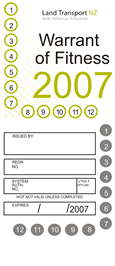
Car inspections have profoundly influenced automotive design, maintenance habits, and public perception of road safety. The requirement for regular checks has fostered a culture of preventative maintenance, encouraging owners to address minor issues before they escalate into major safety hazards or costly repairs. This has, in turn, supported the growth of the automotive repair industry, creating millions of jobs worldwide. Furthermore, emissions testing has been a significant driver in the development of cleaner engine technologies and catalytic converters, contributing to measurable improvements in air quality in many urban centers. The visual cue of an inspection sticker has become a ubiquitous symbol of compliance, a small but potent reminder of the collective effort to maintain safe and environmentally responsible transportation. The debate over the necessity and effectiveness of inspections, however, also highlights public attitudes towards government regulation and personal freedom.
⚡ Current State & Latest Developments
The landscape of car inspections is rapidly evolving with technological advancements. Telematics and remote sensing technologies are being explored for continuous or near-continuous monitoring of vehicle performance and emissions, potentially leading to a paradigm shift away from periodic inspections. Furthermore, the rise of electric vehicles (EVs) presents new challenges and opportunities, as their mechanical complexity differs significantly from internal combustion engine (ICE) vehicles. While EVs have fewer traditional mechanical components to inspect, their battery health, charging systems, and software integrity will likely become focal points for future inspections. The integration of artificial intelligence (AI) in diagnostic tools is also enhancing the speed and accuracy of inspections, allowing for more sophisticated fault detection.
🤔 Controversies & Debates
The necessity and effectiveness of car inspections remain a subject of ongoing debate. Critics argue that mandatory inspections can be costly for vehicle owners, particularly for older vehicles that may require expensive repairs to pass. Some studies have questioned the actual impact of periodic inspections on reducing accident rates, suggesting that factors like driver behavior and vehicle maintenance choices play a more significant role. Conversely, proponents highlight the proven benefits in reducing vehicle emissions and identifying critical safety defects that owners might otherwise overlook. The potential for corruption or biased inspections, where inspectors may pass non-compliant vehicles for a fee or due to personal relationships, is another persistent concern in some jurisdictions. The debate often pits economic efficiency and individual liberty against public safety and environmental protection, with differing regulatory approaches reflecting these competing values.
🔮 Future Outlook & Predictions
The future of car inspections is likely to be shaped by increasing automation, connectivity, and the transition to electric mobility. We can anticipate a move towards more data-driven inspections, potentially utilizing real-time vehicle data transmitted wirelessly from the car to regulatory bodies. This could lead to 'continuous inspection' models where vehicles are monitored throughout their operational life, flagging issues proactively rather than relying on scheduled checks. The development of standardized protocols for EV inspections will be crucial as their market share grows. Furthermore, the integration of advanced driver-assistance systems (ADAS) and autonomous driving technologies will introduce new layers of complexity, requiring inspectors to assess software integrity and sensor functionality. Some futurists predict that by 2040, traditional periodic inspections might become largely obsolete in highly connected regions, replaced by a system of continuous, data-driven compliance monitoring.
💡 Practical Applications
Car inspections are a practical application of regulatory oversight designed to ensure vehicles meet minimum safety and environmental standards before operating on public roads. They are essential for maintaining road safety by identifying potential mechanical failures that could lead to accidents. Furthermore, emissions testing components of inspections directly contribute to environmental protection by reducing harmful pollutants released into the atmosphere. The process also supports the automotive repair industry by creating demand for maintenance and repair services needed to pass inspections. For vehicle owners, passing an inspection is often a prerequisite for registration and legal operation of their vehicle, ensuring compliance with local laws and regulations.
Key Facts
- Category
- technology
- Type
- topic