
Contents
Overview
The concept of executive functions emerged from early 20th-century neuropsychology, particularly studies of patients with frontal lobe damage. Pioneers like Alexander Luria in the mid-20th century laid the groundwork for understanding these higher-order cognitive processes. John Gahan Stuss and Michael Posner further refined these ideas in the late 20th century, distinguishing between different components of executive control and their neural underpinnings. The term itself, while evolving, has consistently pointed to the brain's capacity to override immediate impulses and direct behavior towards long-term objectives, a capacity observed in humans and, to a lesser extent, in other primates.
⚙️ How It Works
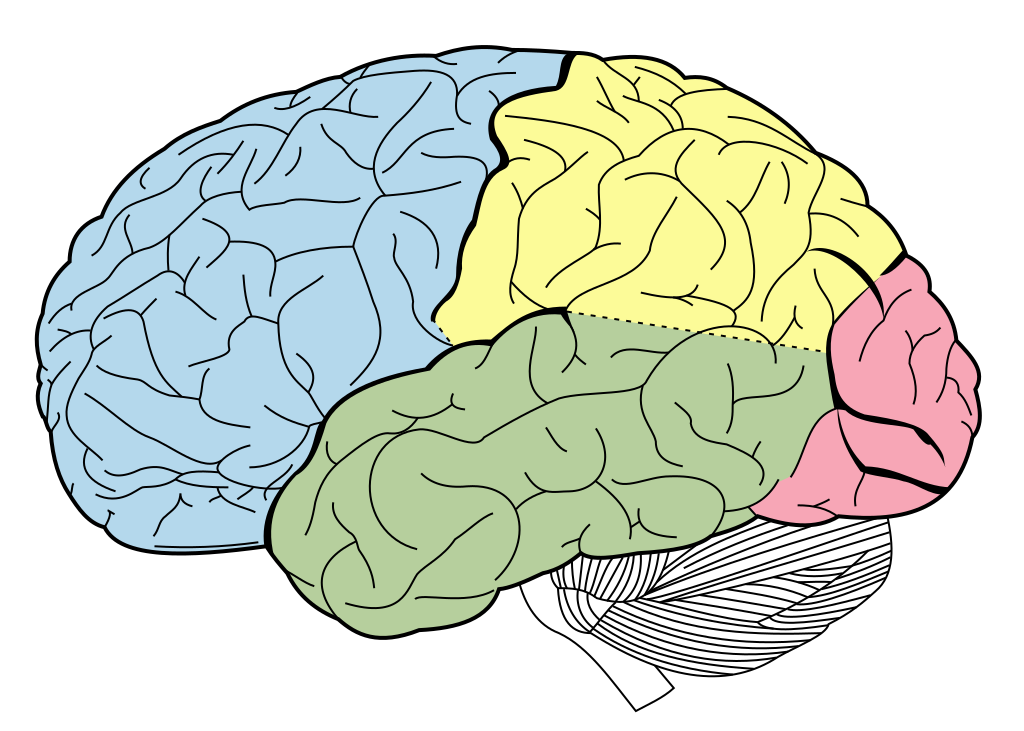
Executive functions operate through a complex interplay of neural networks, primarily involving the prefrontal cortex. Working memory allows us to hold and manipulate information temporarily, essential for tasks like following multi-step instructions. Inhibitory control is the ability to suppress automatic responses or distractions, enabling focus and self-restraint. Cognitive flexibility permits us to switch between tasks or adapt our thinking to changing circumstances. These core components work in concert, orchestrated by the brain's executive control system, to enable higher-level processes like planning, reasoning, and problem-solving, as described by models like Baddeley's model of working memory.
📊 Key Facts & Numbers
Research indicates that executive functions continue to develop throughout adolescence and early adulthood. Studies show that children as young as 3 years old begin to exhibit rudimentary executive skills, which improve by age 5, though complex planning abilities continue to refine. For instance, a child's ability to delay gratification, a key aspect of inhibitory control, has been linked to better life outcomes. The global prevalence of conditions like ADHD, which is characterized by deficits in executive function, highlights the widespread impact of these cognitive processes.
👥 Key People & Organizations
Key figures in the study of executive functions include Alexander Luria, whose work on frontal lobe lesions provided early clinical evidence. Michael Posner is renowned for his research on attention and executive control networks in the brain. Ada Ferrari-Lampert and Philip Zelazo have made significant contributions to understanding the developmental trajectory of executive functions from infancy. The American Psychological Association regularly publishes research and hosts conferences dedicated to cognitive neuroscience, including executive functions. The Society for Neuroscience also hosts conferences dedicated to cognitive neuroscience. The Child Mind Institute is a prominent organization focused on children's mental health, often addressing executive function challenges.
🌍 Cultural Impact & Influence
The influence of executive functions extends far beyond clinical psychology, permeating educational strategies and parenting advice. Educational systems increasingly incorporate methods to foster skills like planning, organization, and self-regulation, recognizing their importance for academic achievement. Parenting programs often focus on developing children's executive skills through structured play, routines, and consistent discipline. The concept of 'grit' and 'growth mindset,' are closely related to the cultivation of executive functions, emphasizing perseverance and the belief in one's ability to improve. The widespread adoption of these concepts underscores the cultural resonance of understanding and enhancing our cognitive control.
⚡ Current State & Latest Developments
Current research is increasingly focused on the neural mechanisms underlying executive functions, utilizing advanced neuroimaging techniques like fMRI and EEG to map brain activity during executive tasks. There's a growing emphasis on personalized interventions for executive function deficits, tailoring strategies based on individual profiles and neurobiological markers. The development of digital tools and apps designed to train executive skills is also a burgeoning area, with platforms like Lumosity and CogniFit offering brain-training exercises. Furthermore, the impact of lifestyle factors such as sleep, diet, and exercise on executive function is a significant area of ongoing investigation, with findings from studies published in journals like Nature Neuroscience consistently highlighting these connections.
🤔 Controversies & Debates
A significant debate revolves around the precise definition and dimensionality of executive functions. Some researchers argue for a unitary 'general executive function,' while others propose distinct, separable components. The extent to which executive functions are malleable through training is also a point of contention; while some studies show significant improvements, others question the transferability of trained skills to real-world contexts. Critics of commercial brain-training programs, such as those reviewed by the Federal Trade Commission, often point to a lack of robust evidence for broad cognitive benefits. The role of genetics versus environment in shaping executive function is another complex area, with ongoing research seeking to disentangle their relative contributions.
🔮 Future Outlook & Predictions
The future of executive function research points towards more sophisticated understanding of its neural basis and more targeted interventions. Advances in artificial intelligence may offer new models for understanding cognitive control and developing AI systems that exhibit more flexible and goal-directed behavior. Personalized medicine approaches, informed by genetic predispositions and neuroimaging data, could lead to highly individualized strategies for enhancing executive functions or mitigating deficits. We can also anticipate a greater integration of executive function training into mainstream education and workplace development programs, moving beyond specialized interventions to become a foundational aspect of human capital development. The potential for brain-computer interfaces to augment executive capabilities, while speculative, represents a frontier for future exploration.
💡 Practical Applications
Executive functions are critical for a wide range of practical applications. In education, they are foundational for learning, enabling students to focus, organize their work, and manage their time effectively. Therapists and psychologists use interventions targeting executive functions to help individuals with conditions like ADHD, autism spectrum disorder, and learning disabilities. In the workplace, strong executive skills are linked to better job performance, leadership potential, and adaptability. For example, project managers rely heavily on planning and organization, while customer service roles demand inhibitory control and cognitive flexibility. Even everyday tasks like cooking a meal or navigating a new city require the coordinated use of multiple executive functions.
Key Facts
- Category
- science
- Type
- topic