
Contents
Overview
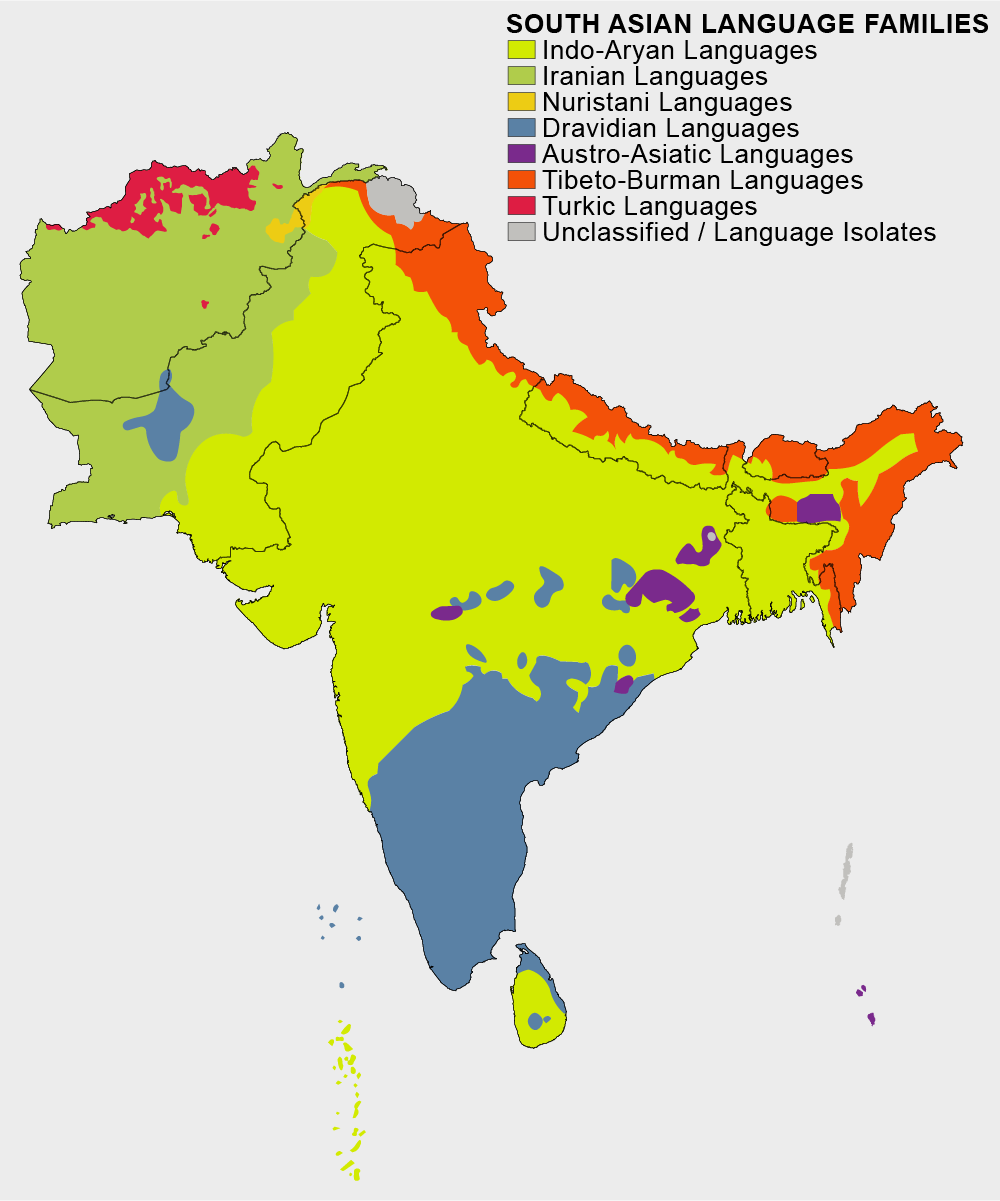
The linguistic origins of South Asia are deeply rooted in ancient migrations and the spread of major language families. The Indo-Aryan languages began their expansion into the subcontinent, displacing or assimilating earlier languages. The Dravidian languages, primarily found in southern India and parts of Sri Lanka, are believed to have an even older indigenous origin, possibly predating the arrival of Indo-Aryan speakers. Later waves of migration brought Tibeto-Burman languages to the Himalayan regions and Austroasiatic languages to eastern India and Bangladesh. The historical interactions between these groups, including periods of Mughal rule and British colonialism, profoundly shaped the linguistic evolution, leading to extensive borrowing and the development of creoles and lingua francas like Hindustani (the basis for modern Hindi and Urdu).
⚙️ How It Works
The structure of South Asian languages varies significantly, though common patterns emerge due to historical contact. Indo-Aryan languages, such as Hindi, Bengali, and Punjabi, typically follow a Subject-Object-Verb (SOV) word order and are characterized by complex inflectional morphology, including grammatical gender and case systems. Dravidian languages, like Tamil and Telugu, also predominantly use SOV order but possess distinct phonological and grammatical features, often lacking grammatical gender and employing agglutinative morphology. Tibeto-Burman languages frequently exhibit tonal systems, a feature less common in Indo-Aryan and Dravidian families. The pervasive influence of Sanskrit on Indo-Aryan languages and Old Tamil on Dravidian languages is evident in their vocabulary and grammatical structures, while Persian and Arabic loanwords are widespread due to centuries of Islamic influence, particularly in Urdu and northern Indo-Aryan languages.
📊 Key Facts & Numbers
South Asia is home to a vast number of distinct languages, spoken by a significant portion of the global population. India alone accounts for a large number of languages, with Hindi and Bengali being among the most spoken. Urdu is understood by hundreds of millions as a lingua franca in Pakistan and parts of India. Punjabi is spoken by many people, primarily in India and Pakistan. Tamil has official status in India, Sri Lanka, and Singapore. The Dravidian family comprises many languages spoken by a large population, while the Indo-Aryan family encompasses a vast number of languages spoken by over a billion people. The Tibeto-Burman languages group includes many languages spoken in the region.
👥 Key People & Organizations
Key figures in the study and standardization of South Asian languages include Sir George Abraham Grierson, whose monumental 'Linguistic Survey of India' remains a foundational text. Scholars like Suniti Kumar Chatterji made significant contributions to understanding the evolution of Indo-Aryan languages, particularly Bengali. In the Dravidian sphere, U. V. Swaminatha Iyer was instrumental in reviving classical Tamil literature. Major academic institutions such as the Central Institute of Indian Languages (CIIL) in Mysore, India, and the University of Delhi's Linguistics Department play crucial roles in research and education. Organizations like the Sahitya Akademi in India promote literary development across its scheduled languages, fostering linguistic preservation and innovation.
🌍 Cultural Impact & Influence
The languages of South Asia are inextricably linked to the region's diverse cultural expressions, from epic poetry and classical music to modern cinema and literature. The rich literary traditions of Sanskrit, Tamil, Bengali, and Urdu have profoundly influenced global literary canons. The concept of linguistic identity is a powerful force in South Asian politics, often driving regional aspirations and national movements. For instance, the linguistic reorganization of states in India was a direct consequence of demands for administrative units based on language. The global diaspora of South Asians has also spread these languages worldwide, contributing to the linguistic diversity of countries like the UK, USA, and Canada. The Bollywood film industry, primarily in Hindi, has a massive global reach, popularizing aspects of Indian culture and language across continents.
⚡ Current State & Latest Developments
In contemporary South Asia, languages are at the forefront of ongoing social and political developments. The push for Hindi as a national language in India continues to be a point of contention, particularly in southern states where Dravidian languages are dominant. The rise of digital media and the internet has led to increased use of regional languages online, with many languages gaining significant traction on platforms like YouTube and Facebook. Efforts to preserve endangered languages, such as Santali and various Tibeto-Burman languages, are gaining momentum, supported by NGOs and government initiatives. The ongoing economic development in countries like Bangladesh and Pakistan is also influencing language use, with English often serving as a crucial language for international business and higher education, creating a dynamic interplay between local tongues and global languages.
🤔 Controversies & Debates
The most persistent controversy surrounding South Asian languages revolves around the concept of a 'national language' versus 'official languages'. In India, the debate over whether Hindi should be the sole national language, or if all 22 scheduled languages should hold equal status, has led to significant political friction, particularly between the Hindi-speaking north and the Dravidian-speaking south. The classification of certain languages as 'major' or 'minor' also sparks debate, with activists arguing that such distinctions can marginalize smaller linguistic communities and threaten their survival. Furthermore, the historical imposition of certain languages during colonial rule and its aftermath continues to be a sensitive topic, with ongoing discussions about linguistic imperialism and the rights of minority language speakers.
🔮 Future Outlook & Predictions
The future of South Asian languages appears to be one of dynamic tension between preservation and globalization. While English is likely to remain dominant in international commerce and higher education, there's a growing recognition of the value of linguistic diversity. We can anticipate increased investment in computational linguistics for South Asian languages, enabling better machine translation, speech recognition, and digital content creation, potentially boosting the online presence of languages like Marathi and Gujarati. The rise of regional media and entertainment industries, particularly in Bengali and Punjabi-speaking areas, suggests these languages will continue to thrive culturally. However, the pressure of urbanization and migration may accelerate the endangerment of smaller languages, making targeted preservation efforts by institutions like the UNESCO and local governments even more critical. The next two decades will likely see a significant digital renaissance for many South Asian languages, but also a continued struggle for recognition and resources for the most vulnerable.
💡 Practical Applications
Understanding the languages of South Asia has direct practical applications across numerous fields. In AI development, creating robust natural language processing (NLP) models for languages like Telugu and Bengali is crucial for expan
Key Facts
- Category
- culture
- Type
- topic