
Contents
Overview
A light-emitting diode (LED) is a solid-state semiconductor device that emits light when an electric current passes through it. This phenomenon, known as electroluminescence, occurs as electrons recombine with electron holes within the semiconductor material, releasing energy as photons. The color of the emitted light is dictated by the semiconductor's band gap energy, with white light typically achieved through phosphors or combinations of different colored LEDs. First appearing as practical components in 1962, early LEDs emitted low-intensity infrared or red light, primarily used for indicator lamps and simple displays. Over decades of innovation, LEDs have evolved into highly efficient, versatile light sources powering everything from consumer electronics and automotive lighting to architectural illumination and large-scale displays, fundamentally reshaping how we generate and perceive light.
🎵 Origins & History
The genesis of the light-emitting diode traces back to the early 20th century with observations of electroluminescence. Early LEDs emitted low-intensity infrared or red light, initially finding use as simple indicator lights in electronic equipment, replacing less efficient incandescent bulbs. The development of blue LEDs in the early 1990s by Shuji Nakamura and his colleagues at Nichia Corporation was a pivotal moment, paving the way for white light LEDs and revolutionizing illumination.
⚙️ How It Works
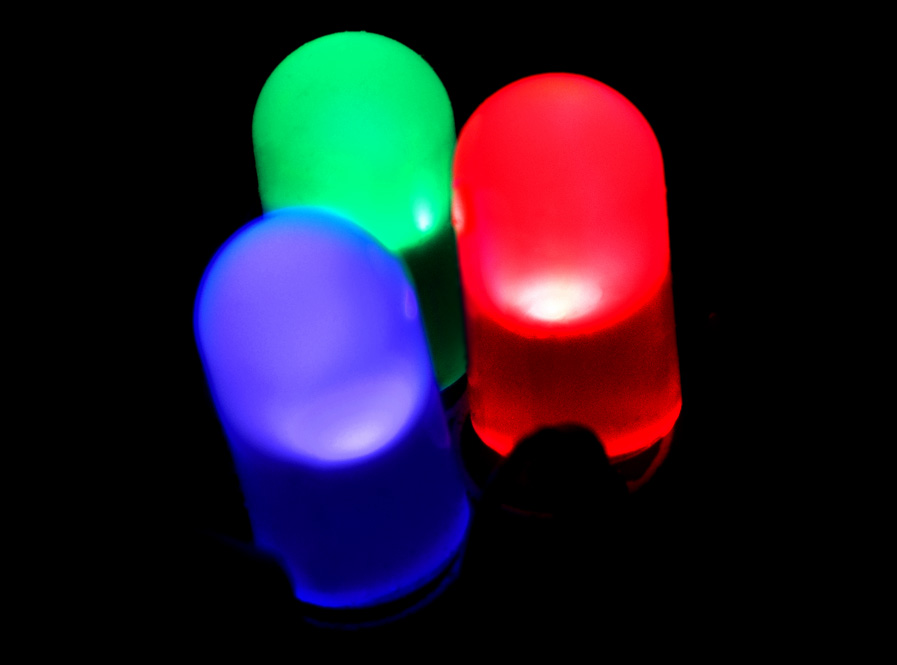
At its core, an LED operates on the principle of electroluminescence within a semiconductor junction. When a forward voltage is applied, electrons from the n-type region and holes from the p-type region are injected into the depletion region. Here, they recombine, releasing energy. The energy difference, or band gap, of the semiconductor material determines the energy of the emitted photons, and thus the color of the light. For instance, GaAsP alloys produce red and yellow light, while GaN and InGaN are crucial for blue and green light. White light is typically achieved by coating a blue LED with a yellow phosphor, which absorbs some blue light and re-emits it as yellow, creating a broad spectrum that appears white to the human eye, or by combining red, green, and blue LEDs.
📊 Key Facts & Numbers
LEDs now account for over 80% of the general lighting market in developed countries, a stark contrast to their niche status just two decades ago. The luminous efficacy of modern LEDs can exceed 200 lumens per watt, vastly outperforming traditional incandescent bulbs (around 15 lm/W) and even fluorescent lamps (around 70-100 lm/W). The lifespan of an LED is typically 25,000 to 50,000 hours, meaning a single bulb could last over 20 years under normal usage.
👥 Key People & Organizations
Key figures in LED development include Nick Holonyak Jr., often called the 'father of the LED' for his visible-light invention at General Electric in 1962. Shuji Nakamura, Isamu Akasaki, and Hiroshi Amano were jointly awarded the Nobel Prize in Physics in 2014 for the invention of efficient blue LEDs, a breakthrough that enabled energy-saving white light sources. Major players in the LED manufacturing industry include Signify N.V. (formerly Philips Lighting), Osram, Cree, and Nichia Corporation, each contributing significantly to technological advancements and market expansion.
🌍 Cultural Impact & Influence
LEDs have fundamentally reshaped visual culture and energy consumption. Their compact size and durability enabled the proliferation of small, bright displays in everything from mobile phones and televisions to digital signage and stadium screens. The shift from incandescent and fluorescent lighting to LEDs has led to substantial energy savings globally; for instance, the U.S. Department of Energy estimated that widespread adoption of LEDs could save over $265 billion in energy costs and prevent billions of tons of carbon emissions by 2030. Furthermore, the ability to precisely control color and intensity has opened new avenues in horticulture (grow lights), medical phototherapy, and even mood lighting, demonstrating a pervasive influence on daily life.
⚡ Current State & Latest Developments
The current landscape of LED technology is characterized by relentless innovation in efficiency, color rendering, and smart integration. Manufacturers are pushing luminous efficacy beyond 200 lumens per watt, with research targeting 300 lm/W. The development of Quantum Dot LEDs (QLEDs) offers enhanced color purity and brightness, particularly in display applications. Smart LEDs, controllable via Wi-Fi or Bluetooth, are becoming standard, allowing for dynamic color changes, dimming, and integration with home automation systems like Amazon Alexa and Google Assistant. The automotive sector continues to adopt advanced LED lighting for headlights, taillights, and interior ambiance, with matrix LED headlights offering adaptive illumination that avoids dazzling other drivers.
🤔 Controversies & Debates
Despite their widespread adoption, LEDs are not without controversy. The 'blue light' emitted by many LEDs, especially in cooler color temperatures, has raised concerns about potential disruption to human circadian rhythms and eye strain, leading to debates about optimal color temperature recommendations for different applications. The environmental impact of manufacturing LEDs, particularly the use of rare earth elements and the disposal of electronic waste, is another area of concern, though generally considered less impactful than older lighting technologies. Furthermore, the rapid obsolescence of LED technology, driven by constant efficiency gains, can lead to premature replacement and increased waste.
🔮 Future Outlook & Predictions
The future of LED technology points towards even greater efficiency, novel applications, and deeper integration with smart systems. Researchers are exploring new semiconductor materials and quantum effects to push luminous efficacy towards theoretical limits, potentially exceeding 300 lm/W. The development of Li-Fi (Light Fidelity) technology, which uses LEDs to transmit data at high speeds, is poised to offer a new wireless communication paradigm. We can also expect advancements in tunable LEDs that can precisely mimic natural sunlight, offering significant benefits for human health and well-being. The integration of LEDs into flexible substrates and transparent displays will likely lead to entirely new product designs and interactive surfaces.
💡 Practical Applications
LEDs are ubiquitous in modern life, serving a vast array of practical applications. In general illumination, they are the standard for homes, offices, and public spaces due to their energy efficiency and long lifespan. In displays, they form the basis of OLED and QLED screens found in televisions, smartphones, and computer monitors, offering superior contrast and color. Automotive lighting relies heavily on LEDs for headlights, taillights, and interior lighting, enhancing safety and design. Horticultural LEDs provide optimized light spectrums for plant growth in controlled environments, while medical applications include phototherapy and surgical lighting. Their use as indicator lights remains prevalent in countless electronic devices.
Key Facts
- Category
- technology
- Type
- technology