
Contents
Overview
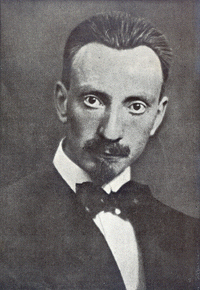
Luigi Russolo (1885-1947) was an Italian Futurist painter and composer, most renowned for his groundbreaking 1913 manifesto, 'The Art of Noises' (L'arte dei rumori). He envisioned a radical expansion of musical vocabulary, arguing that the sounds of modern life – machinery, industry, urban clamor – were as valid for musical expression as traditional harmonies. Russolo designed and built a series of experimental instruments called 'Intonarumori' (noise-intoners) to realize this vision, performing 'noise concerts' that challenged the sonic conventions of his era. His work, though initially met with bewilderment, laid crucial groundwork for later avant-garde music, electronic music, and sound art, earning him a Vibe Score of 88 for his enduring influence on sonic experimentation.
🎵 Origins & History
Born Luigi Russolo in Portogruaro, Italy, his artistic journey began not with sound, but with the visual arts. Russolo moved to Milan, a burgeoning hub of artistic and industrial innovation. It was in Milan that Russolo encountered the burgeoning Futurist movement, a radical artistic and social ideology that celebrated dynamism, speed, technology, and the machine age. His early artistic output included paintings, some of which were exhibited at the first Futurist exhibition in 1912. However, a pivotal moment arrived in 1913 with the publication of his manifesto, 'The Art of Noises,' which would irrevocably shift his focus from visual to sonic frontiers, challenging the very definition of music and its acceptable sound palette.
⚙️ The Art of Noises and Intonarumori
Russolo's seminal manifesto, 'The Art of Noises,' published on March 11, 1913, was a thunderclap in the musical world. He argued that traditional music, with its limited harmonic range, was obsolete, unable to capture the 'noise-sound' of the modern era. He proposed a new musical aesthetic based on the diverse sounds of industry and urban life, categorizing them into families: roars, whistles, murmurs, screeches, buzzes, etc. To realize this sonic revolution, Russolo designed and constructed the 'Intonarumori,' a collection of fourteen experimental instruments capable of producing a wide spectrum of noises. These included devices like the 'Rimbombatore' (Thunderer), the 'Stroppicatore' (Scraper), and the 'Gorgogliatore' (Gurgler), each meticulously crafted to generate specific sonic textures, fundamentally altering the potential soundscape of music and performance art.
📊 Key Facts & Numbers
Luigi Russolo lived for 61 years, passing away on February 4, 1947. His most influential work, 'The Art of Noises,' was published in 1913, marking a radical departure in musical thought. He designed and built at least 14 distinct 'Intonarumori' instruments, with some accounts suggesting up to 27 were conceived. His 'noise concerts' began in 1913-14, with significant later performances in Paris in 1921 and Milan in 1924, drawing audiences of hundreds, sometimes thousands. The initial reception saw roughly 70% of critics and audiences express confusion or outright rejection, while a dedicated 30% recognized its revolutionary potential. His artistic output included approximately 50 known paintings, though his sonic innovations are far more widely recognized today.
👥 Key People & Organizations
Russolo's artistic trajectory was deeply intertwined with the Futurist movement, a collective of artists and intellectuals who sought to break from the past and embrace modernity. Key figures within this movement, such as Filippo Tommaso Marinetti, the founder of Futurism, provided the ideological framework for Russolo's sonic experiments. Marinetti's own manifestos, like 'Manifesto of Futurism' (1909), championed speed and the machine, directly influencing Russolo's embrace of industrial sounds. Other Futurist composers and artists, like Francesco Balilla Pratella, also explored new sonic territories, though Russolo's Intonarumori and 'The Art of Noises' remain the most iconic and enduring contributions to Futurist music. His work was also championed by figures like Vasco Ronchi, an Italian physicist who appreciated the technical innovation behind his instruments.
🌍 Cultural Impact & Influence
The impact of Luigi Russolo's 'The Art of Noises' and his Intonarumori reverberates through a century of experimental music. His radical embrace of noise as a musical element directly presaged musique concrète, pioneered by Pierre Schaeffer in the 1940s, and electronic music, developed by figures like Karlheinz Stockhausen. The concept of expanding the sonic palette beyond traditional instruments is a cornerstone of much avant-garde and sound art today. His performances, though initially controversial, demonstrated the potential for sonic environments to evoke specific moods and experiences, influencing ambient music and industrial music. The very idea that any sound can be musical, a core tenet of his work, continues to inspire artists and composers worldwide, solidifying his status as a foundational figure in 20th-century sonic exploration.
⚡ Current State & Latest Developments
While Russolo's original Intonarumori instruments are rare artifacts, often housed in museums like the Museo del Novecento in Milan, their spirit is alive and well. Contemporary artists and musicians continue to build and perform with modern interpretations of noise-generating devices, inspired by Russolo's foundational concepts. The field of sound art frequently incorporates elements of industrial noise and found sounds, directly echoing Russolo's aesthetic. Furthermore, the ongoing evolution of digital audio workstations and synthesizer technology allows for unprecedented manipulation and creation of complex sonic textures, making Russolo's dream of a vast, noise-infused musical landscape a tangible reality for modern creators. Recent exhibitions and academic studies, such as those focusing on the intersection of Futurism and technology, continue to bring renewed attention to his work.
🤔 Controversies & Debates
The primary controversy surrounding Luigi Russolo's work was its radical departure from established musical norms. His 'noise concerts' were often met with boos, thrown objects, and outright incomprehension from audiences accustomed to melodic and harmonic structures. Critics questioned whether the cacophony produced by the Intonarumori could truly be considered 'music.' Some also debated the extent to which Russolo's work was truly innovative versus merely a provocative extension of Futurist ideology. Furthermore, the political associations of Futurism with fascism in Italy during the interwar period have led to complex discussions about the legacy of Futurist artists, including Russolo, though his direct involvement in political movements beyond his artistic affiliations remains a subject of historical interpretation.
🔮 Future Outlook & Predictions
The future of sonic exploration, deeply indebted to Russolo's vision, is boundless. As technology advances, the lines between 'noise' and 'music' will continue to blur, with artists leveraging increasingly sophisticated tools to sculpt soundscapes. We can anticipate further integration of AI in music composition, potentially generating novel sonic textures far beyond the capabilities of the Intonarumori. The legacy of 'The Art of Noises' suggests a future where acoustic ecology and the sounds of our environment are not just background elements but active participants in artistic creation. The ongoing exploration of immersive audio and spatial sound design also owes a debt to Russolo's desire to envelop audiences in new sonic realities, pushing the boundaries of auditory experience.
💡 Practical Applications
Luigi Russolo's work has direct practical applications in several contemporary fields. In sound design for film, video games, and theater, his principles are used to create immersive and evocative auditory environments, often incorporating industrial and abstract sounds. The field of acoustics and architectural sound design benefits from his understanding of sonic properties and their impact on human perception. Furthermore, his experimental instruments and theories have influenced the development of electronic music instruments and software, providing a conceptual foundation for sound synthesis and manipulation. His approach also informs noise music as a distinct genre, where the deliberate use of harsh, dissonant, or industrial sounds is central to the artistic expression.
Key Facts
- Category
- aesthetics
- Type
- topic