
Contents
Overview
The study of ocean currents has a long and evolving history, stretching back to ancient mariners who observed surface drifts for navigation. Early scientific investigations began in earnest during the Age of Exploration, with figures like Ferdinand Magellan noting the consistent flow of water. However, it wasn't until the late 19th and early 20th centuries that systematic scientific inquiry began to unravel the complex dynamics. Matthew Fontaine Maury, often called the "father of physical oceanography," published his seminal work "The Physical Geography of the Sea" in 1855, compiling vast amounts of ship log data to map prevailing currents. Later, expeditions like the German Meteor Expedition (1925-1927) utilized advanced instruments like echo sounders and current meters to map the ocean floor and measure deep-sea currents, laying the groundwork for modern oceanographic understanding of global circulation patterns.
⚙️ How It Works
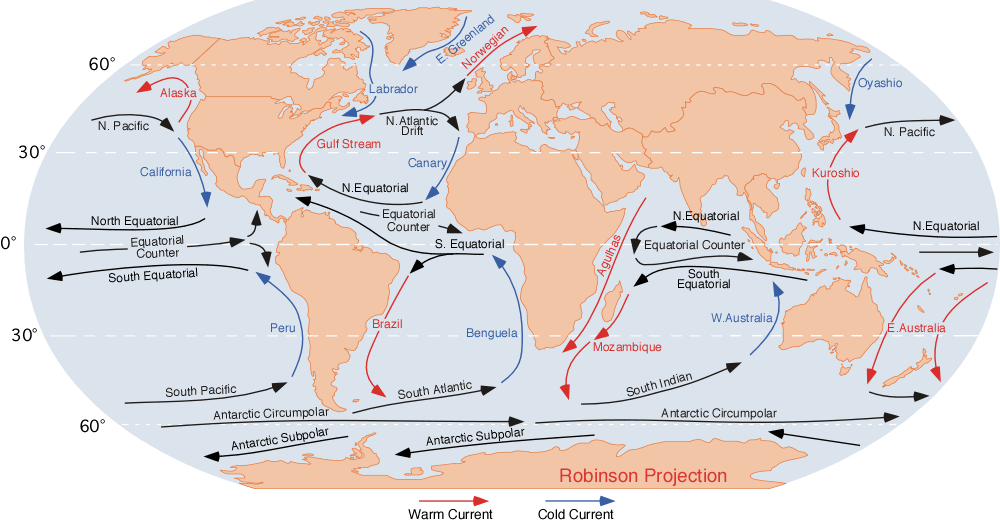
Ocean currents are generated by a confluence of forces. Surface currents are primarily driven by prevailing winds, which exert drag on the water's surface, initiating movement. The Coriolis effect, a result of Earth's rotation, deflects these moving waters to the right in the Northern Hemisphere and to the left in the Southern Hemisphere, leading to the formation of large circular patterns known as gyres. Deep ocean currents, collectively known as thermohaline circulation, are driven by differences in water density, which are determined by temperature and salinity. Cold, salty water is denser and sinks, initiating a slow, global conveyor belt that circulates water masses over centuries. Other factors like tidal forces, underwater topography, and the convergence of different water masses also play significant roles in shaping current behavior.
📊 Key Facts & Numbers
The sheer scale of ocean currents is staggering: the Gulf Stream alone transports an estimated 150 million cubic meters of water per second, more than 100 times the flow of all the world's rivers combined. The global ocean conveyor belt, a critical component of Earth's climate system, moves approximately 2 million cubic meters of water per second. These currents are responsible for transporting an immense amount of heat; the Gulf Stream transports more heat than all of the world's rivers combined. The ocean absorbs about 90% of the excess heat trapped by greenhouse gases, and currents are the primary mechanism for distributing this heat across the globe. The Pacific Ocean's Kuroshio Current is another major western boundary current, comparable in volume to the Gulf Stream. The average speed of major ocean currents can range from 0.1 to 2 meters per second (0.2 to 4.5 mph).
👥 Key People & Organizations
Pioneering figures like Matthew Fontaine Maury laid the foundation for understanding ocean currents through meticulous data collection. Modern oceanography relies on the work of institutions such as the Woods Hole Oceanographic Institution (WHOI) and the Scripps Institution of Oceanography, which conduct cutting-edge research and deploy advanced technologies. Organizations like the National Oceanic and Atmospheric Administration (NOAA) play a crucial role in monitoring and predicting current behavior, providing vital data for climate modeling and maritime safety. The Intergovernmental Panel on Climate Change (IPCC) synthesizes this research to assess the impact of currents on global climate. Key figures in modern physical oceanography include Carl Wunsch, known for his work on ocean circulation, and Susan Lozier, who has made significant contributions to understanding the Atlantic Meridional Overturning Circulation (AMOC).
🌍 Cultural Impact & Influence
Ocean currents have profoundly shaped human history and culture. For millennia, they have been indispensable for maritime trade and exploration, with explorers like Christopher Columbus relying on predictable currents for transatlantic voyages. The discovery of currents like the Gulf Stream by Benjamin Franklin in the 1770s not only aided navigation but also sparked early scientific curiosity. These currents influence weather patterns, affecting everything from agricultural yields to the distribution of marine life, which in turn impacts coastal communities and fishing industries. The visual spectacle of powerful currents and their effects on coastlines has also inspired art, literature, and mythology across various cultures, often personifying them as powerful, unpredictable forces of nature.
⚡ Current State & Latest Developments
Current research is intensely focused on the impacts of climate change on ocean circulation. Scientists are observing potential slowdowns in key currents like the Atlantic Meridional Overturning Circulation (AMOC), a phenomenon that could have drastic consequences for global weather patterns, particularly in Europe and North America. The increasing rate of ice melt in Greenland is altering ocean salinity and density, which are critical drivers of thermohaline circulation. Furthermore, advancements in satellite oceanography and autonomous underwater vehicles (AUVs) are providing unprecedented real-time data on current dynamics, enabling more accurate climate models and short-term weather forecasts. The study of mesoscale eddies, smaller turbulent swirls within larger currents, is also gaining traction for its role in nutrient transport and energy dissipation.
🤔 Controversies & Debates
One of the most significant debates revolves around the potential for a complete shutdown or drastic weakening of the Atlantic Meridional Overturning Circulation (AMOC) due to accelerated ice melt in Greenland. While most models suggest a slowdown rather than a complete collapse, the precise tipping point and the cascading effects remain subjects of intense scientific scrutiny and public concern. Another area of contention is the precise role of ocean currents in sequestering atmospheric carbon dioxide and how this capacity might change with warming oceans and altered circulation patterns. The economic implications of shifting currents, particularly for global fisheries and shipping routes, also generate debate among policymakers and industry stakeholders.
🔮 Future Outlook & Predictions
The future of ocean currents is inextricably linked to global climate trajectories. Projections from the IPCC's Sixth Assessment Report indicate a continued weakening of the AMOC throughout the 21st century, with significant regional climate implications. Researchers are exploring the potential for geoengineering solutions, such as artificial upwelling or downwelling, though these remain highly speculative and controversial. The development of more sophisticated AI-driven climate models promises to improve our understanding and prediction of current behavior, potentially allowing for better adaptation strategies. The ongoing exploration of the deep ocean may also reveal previously unknown current systems and their roles in biogeochemical cycles, further refining our global oceanographic models.
💡 Practical Applications
Ocean currents have numerous practical applications. They are fundamental to maritime navigation, with shipping companies optimizing routes to take advantage of or avoid specific currents to save fuel and time. Fisheries management relies heavily on understanding current patterns, as they transport nutrients and influence the distribution and migration of commercially important fish stocks. Ocean energy technologies, such as tidal turbines and ocean thermal energy conversion (OTEC), are being developed to harness the kinetic and thermal energy of currents. Furthermore, currents play a crucial role in the dispersal of marine larvae and pollutants, making them vital for underst
Key Facts
- Category
- nature
- Type
- topic