
Contents
- 🎵 Origins & History
- ⚙️ How It Works
- 📊 Key Facts & Numbers
- 👥 Key People & Organizations
- 🌍 Cultural Impact & Influence
- ⚡ Current State & Latest Developments
- 🤔 Controversies & Debates
- 🔮 Future Outlook & Predictions
- 💡 Practical Applications
- 📚 Related Topics & Deeper Reading
- Frequently Asked Questions
- References
- Related Topics
Overview
The Oracle of Delphi, known through its high priestess, the Pythia, traces its origins to the sacred sanctuary of Apollo at Delphi, nestled on the slopes of Mount Parnassus. While the temple's cult may extend as far back as 1400 BC, the oracle's formalized role as a prophetic voice is generally dated to the 8th century BC, emerging as a pre-eminent religious and political force by the late 7th century BC. Early accounts suggest the Pythia inherited her prophetic mantle from the serpent Python, slain by Apollo, and that her pronouncements were initially delivered through a priest who interpreted her ecstatic utterances. Over centuries, the Pythia herself became the direct conduit, her pronouncements shaping the decisions of kings, city-states, and individuals across the Hellenic world and beyond, influencing everything from the establishment of colonies like Cyrene to the outcome of conflicts such as the Persian Wars.
⚙️ How It Works
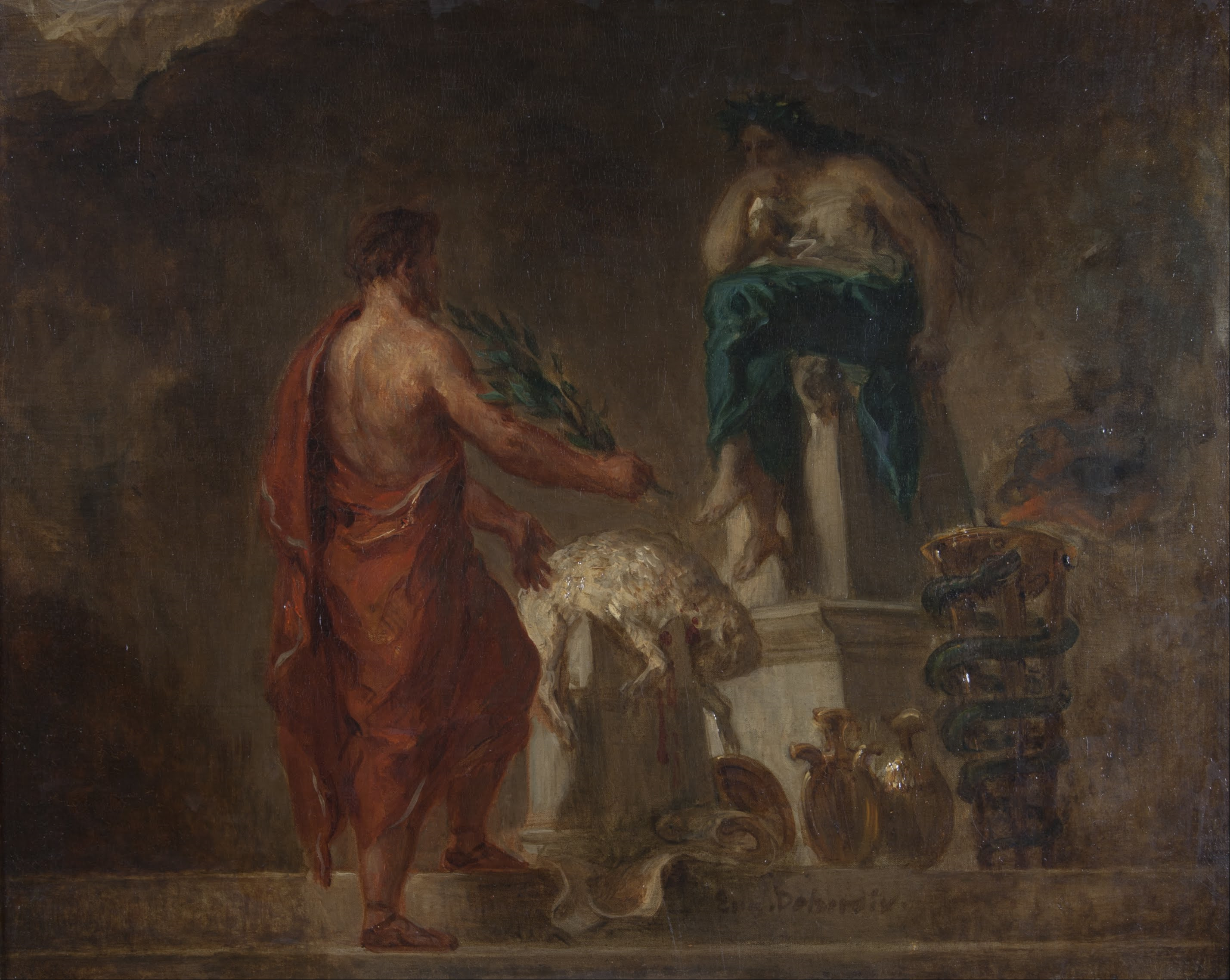
The ritualistic process of consulting the Oracle of Delphi was elaborate and steeped in tradition. Aspirants first purified themselves and offered a sacrifice, typically a goat, to Apollo. If the goat trembled, it indicated divine favor for the consultation. The Pythia, after bathing in the sacred waters of the Castalian Spring and chewing laurel leaves, would descend into the adyton, a subterranean chamber within the Temple of Apollo. Here, seated on a tripod over a chasm believed to emit intoxicating vapors, she would enter a state of divine possession (enthusiasmos), uttering prophecies that were then transcribed and interpreted by priests. These pronouncements, often delivered in hexameter verse, were notoriously ambiguous, requiring careful interpretation by the supplicant, a process that itself became a significant part of the oracle's power and mystique, as seen in the famous advice given to Croesus regarding his war with Persia.
📊 Key Facts & Numbers
The Oracle of Delphi held sway for an extraordinary duration, consulted from at least the 8th century BC until its official cessation in the late 4th century AD, a span of over 1,000 years. During its zenith, an estimated tens of thousands of oracular consultations occurred annually, with major city-states like Athens and Sparta dedicating significant resources and sending envoys to seek guidance. The temple complex itself was vast, funded by offerings that accumulated immense wealth, estimated to be in the billions of contemporary dollars, making it one of the wealthiest religious institutions of antiquity. The oracle's pronouncements influenced the colonization of over 100 Greek city-states and played a role in major political decisions, including the advice given to Lycurgus for his Spartan constitution.
👥 Key People & Organizations
The Oracle of Delphi was intrinsically linked to the god Apollo, who was believed to possess the Pythia. The high priestess, the Pythia, was the central figure, though her identity was often veiled, with multiple women serving in rotation over the centuries. The priests of Apollo at Delphi played a crucial role as intermediaries, transcribing and interpreting the Pythia's prophecies; notable among them were figures like Chilon of Sparta, one of the Seven Sages, who served as a priest. The Delphic Amphictyony, a league of twelve Greek tribes, was responsible for the administration and protection of the sanctuary, ensuring its neutrality and continued operation. Even figures like Socrates, though famously skeptical of oracles, acknowledged the pronouncements from Delphi, particularly the famous declaration that no man was wiser than he.
🌍 Cultural Impact & Influence
The cultural impact of the Oracle of Delphi reverberated throughout the ancient world, shaping not only political and military strategies but also the very fabric of Greek thought and mythology. Its pronouncements influenced the development of Greek drama, with playwrights like Sophocles and Euripides frequently incorporating oracular advice into their narratives, such as the prophecy of Oedipus's fate in Oedipus Rex. The oracle's ambiguous advice also fostered a culture of interpretation and philosophical inquiry, prompting thinkers like Heraclitus to reflect on the nature of divine pronouncements and the limits of human understanding. The concept of fate, or 'moira', became deeply ingrained in the Greek worldview, often perceived as being divinely ordained through the Delphic pronouncements, a notion explored extensively in Plato's dialogues.
⚡ Current State & Latest Developments
While the ancient Oracle of Delphi ceased its operations in the late 4th century AD under the influence of Christianity, the site of Delphi remains an archaeological marvel and a UNESCO World Heritage site. Modern archaeological investigations, particularly those conducted by the French School at Athens since the late 19th century, continue to uncover new insights into the temple's structure and the rituals performed there. While direct prophetic pronouncements are a thing of the past, the legacy of the oracle persists in modern interpretations of ancient history and its influence on Western thought. Contemporary discussions often revolve around the geological and chemical factors that might have contributed to the Pythia's trance-like states, with studies examining the potential role of volatile gases emanating from subterranean fissures, a theory first proposed by geologists in the late 20th century.
🤔 Controversies & Debates
The precise mechanism by which the Pythia delivered her prophecies has been a subject of intense debate for centuries. One prominent controversy centers on the nature of the intoxicating vapors emanating from the adyton. While ancient sources like Plutarch describe them, early modern scholars often dismissed this as myth. However, geological surveys in the late 20th century identified seismic fault lines beneath the temple site, suggesting the possibility of natural gas emissions, such as ethylene, which could induce hallucinatory states. Skeptics, however, argue that the evidence for significant gas emissions is inconclusive and that the Pythia's pronouncements were more likely a product of psychological manipulation, ritualistic trance, or even deliberate fabrication by the priests. The extent to which the Pythia was genuinely divinely inspired versus a tool of political influence remains a core point of contention.
🔮 Future Outlook & Predictions
The future of understanding the Oracle of Delphi lies in interdisciplinary research, blending archaeology, geology, and religious studies. Future excavations may reveal more about the adyton's precise structure and the nature of any subterranean phenomena. Advanced geological analysis could definitively confirm or refute the presence and impact of intoxicating gases. Furthermore, comparative studies with other ancient prophetic traditions, such as those found in Egypt or the Roman Empire, might illuminate common patterns in ecstatic communication and ritual. The ongoing quest to understand the oracle's influence will likely continue to inspire new interpretations of its role in shaping the course of ancient Greek civilization and its enduring impact on Western culture.
💡 Practical Applications
The primary practical application of studying the Oracle of Delphi today lies in understanding ancient decision-making processes, the power of religious institutions, and the psychology of belief. Historians and political scientists analyze the oracle's pronouncements to gauge the political climate of ancient Greece and the strategies employed by city-states. Psychologists and neuroscientists explore the potential physiological and psychological factors contributing to the Pythia's trance states, offering insights into altered states of consciousness. Furthermore, the oracle's legacy serves as a case study in the construction and maintenance of authority, demonstrating how ambiguity and perceived divine sanction can be wielded to influence collective action and shape societal norms, a phenomenon still observable in various forms of modern leadership and media.
Key Facts
- Year
- c. 8th century BC - 4th century AD
- Origin
- Delphi, Greece
- Category
- history
- Type
- concept
Frequently Asked Questions
Who was the Oracle of Delphi?
The Oracle of Delphi was the high priestess, known as the Pythia, who served at the Temple of Apollo in Delphi, Greece. She was believed to channel prophecies directly from the god Apollo, making her pronouncements highly influential in the ancient Greek world. Her role was central to religious and political decision-making for over a thousand years, from approximately the 8th century BC to the late 4th century AD, impacting everything from personal choices to state affairs and military campaigns.
How did the Oracle of Delphi deliver prophecies?
The Pythia would enter a trance-like state, believed to be divinely induced by Apollo, while seated on a tripod over a chasm in the temple's inner sanctum (adyton). She would chew laurel leaves and inhale vapors believed to emanate from the earth. In this state, she would utter cryptic phrases and sounds, which were then transcribed and interpreted by priests. These interpretations, often ambiguous, were then conveyed to the supplicants, who had to discern the meaning for their specific situation, a process that itself added to the oracle's mystique and authority.
What was the significance of the Oracle of Delphi?
The Oracle of Delphi was arguably the most important and authoritative oracle in the ancient Greek world. Its pronouncements guided critical decisions for individuals, city-states, and even empires, influencing colonization, warfare, and legislation. It served as a unifying religious and cultural center for the disparate Greek city-states, fostering a shared sense of identity and destiny. The oracle's prestige was so immense that its advice was sought by rulers and commoners alike, making it a pivotal institution in shaping Hellenic history and thought for over a millennium.
What happened to the Oracle of Delphi?
The Oracle of Delphi gradually declined in influence with the rise of Christianity and the Roman Empire's eventual adoption of the religion. Emperor Theodosius I is often credited with officially closing the pagan temples, including the Temple of Apollo at Delphi, around 393 AD. While the exact date of its final cessation is debated, its active prophetic role ended by the late 4th century AD. The site, however, remained an important archaeological location, and its legacy continues to be studied and debated by historians and classicists.
Was the Oracle of Delphi real or a hoax?
The question of the Oracle's 'reality' is complex. The Pythia was a real person performing real rituals, and her pronouncements were taken very seriously by ancient Greeks. The debate centers on the source of her prophetic ability: divine inspiration, psychological phenomena, or deliberate priestly manipulation. Geological evidence suggests potential hallucinogenic gases from fissures, supporting a physiological basis for her trance. However, the ambiguity of the prophecies allowed for flexible interpretation, meaning even if the Pythia's utterances were not divinely dictated, their perceived accuracy could be high due to the interpretive skill of the priests and the psychological impact on supplicants seeking answers.
How did people consult the Oracle of Delphi?
Consulting the Oracle involved a formal process. Individuals or official delegations from city-states would travel to Delphi, undergo purification rituals, and offer sacrifices, typically a goat, to Apollo. If the sacrifice was deemed favorable (indicated by the goat trembling), the supplicant would pay a fee and await their turn. The Pythia would then enter her trance and deliver her prophecy, which was recorded and interpreted by the temple priests before being given to the inquirer. The cost and complexity of the process meant that consultations were often reserved for significant matters.
What are some famous prophecies from the Oracle of Delphi?
One of the most famous prophecies was given to Croesus, king of Lydia, who was advised that if he attacked Persia, he would destroy a great empire. He interpreted this to mean he would conquer Persia, but in fact, he destroyed his own Lydian empire. Another significant pronouncement was given to Themistocles of Athens, who was told to trust in 'wooden walls' to save the city, which he interpreted as their fleet of ships, leading to the Athenian victory at the Battle of Salamis during the Persian Wars. Socrates also famously received a prophecy that no man was wiser than he, which he spent his life trying to understand.