
Contents
Overview
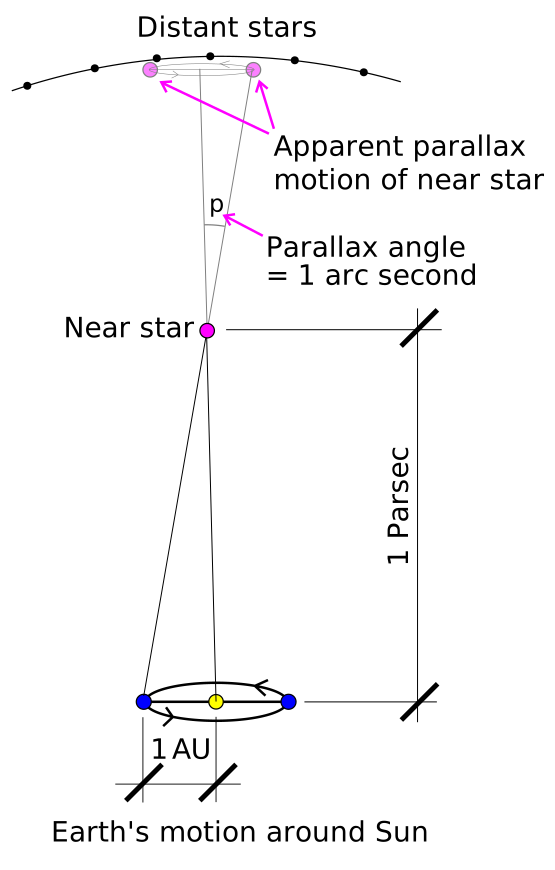
The parsec (pc) is a unit of astronomical distance, indispensable for comprehending the vast scales of the universe beyond our solar system. Defined by the geometric principle of parallax, it represents the distance at which one astronomical unit (the average distance between the Earth and the Sun) subtends an angle of one arcsecond – a mere 1/3600th of a degree. This unit, approximately 3.26 light-years or 30.9 trillion kilometers, allows astronomers to translate subtle shifts in stellar positions into concrete measurements of cosmic gulfs. From the nearest star, Proxima Centauri, at a mere 1.3 parsecs away, to the sprawling Andromeda Galaxy situated over 700,000 parsecs distant, the parsec provides a tangible scale for the otherwise unfathomable emptiness of space. Its adoption in the early 20th century streamlined astronomical calculations, transforming abstract parallax measurements into a practical tool for mapping the cosmos.
🎵 Origins & History
The parsec's genesis can be traced to the early 20th century, a period of burgeoning astronomical precision. British astronomer Herbert Hall Turner is credited with coining the term in 1913, a portmanteau derived from 'parallax' and 'arcsecond.' This neologism was not merely an academic exercise; it was a pragmatic response to the growing need for a standardized unit that directly reflected the observational method of parallax, which measures a star's apparent shift against the background as the Earth orbits the Sun. Before the parsec, astronomers relied on less intuitive units or cumbersome calculations. The International Astronomical Union (IAU) formally adopted the parsec as a standard unit in 1922, solidifying its place in astronomical discourse and research, replacing earlier, less standardized units like the 'astronomical unit' for interstellar distances.
⚙️ How It Works
The parsec is fundamentally a trigonometric construct. Imagine a right-angled triangle where the Earth's orbital radius (1 AU) forms one short side, and the distance to a star forms the hypotenuse. The angle opposite the AU side, measured from the star's perspective, is the parallax angle. When this angle is precisely one arcsecond (1/3600th of a degree), the star is defined to be one parsec away. This elegant geometric relationship means that as a star's parallax angle decreases, its distance in parsecs increases proportionally. For instance, a star with a parallax of 0.5 arcseconds is 2 parsecs away, while a star with a parallax of 2 arcseconds is 0.5 parsecs away. This inverse relationship is key to its utility in mapping stellar positions.
📊 Key Facts & Numbers
A single parsec equates to approximately 3.26 light-years, a staggering 30.9 trillion kilometers (19.2 trillion miles), or about 206,265 astronomical units (AU). The nearest star system to our Sun, Alpha Centauri, lies at roughly 1.3 parsecs (about 4.24 light-years). Many stars visible to the naked eye are within a few hundred parsecs, while the most distant stars observable without advanced telescopes are typically a few thousand parsecs away. For context, the Milky Way Galaxy itself spans an estimated 30,000 parsecs in diameter. The Andromeda Galaxy, our nearest major galactic neighbor, is a colossal 770,000 parsecs distant, illustrating the immense scales the parsec is designed to measure.
👥 Key People & Organizations
The concept of the parsec was championed by astronomers like Herbert Hall Turner, who recognized the need for a standardized unit derived directly from parallax measurements. The International Astronomical Union (IAU), established in 1919, played a crucial role in formally adopting and promoting the parsec. While individual observatories and national astronomical societies had been using various distance units, the IAU's endorsement lent the parsec universal authority. Key figures in early 20th-century astronomy, such as Ejnar Hertzsprung and Arthur Eddington, utilized and popularized the parsec in their seminal works on stellar distances and galactic structure, further cementing its importance.
🌍 Cultural Impact & Influence
The parsec has profoundly shaped our perception of the cosmos, transforming abstract astronomical data into comprehensible spatial relationships. It provides a common language for astronomers worldwide, enabling collaborative research and the construction of large-scale galactic maps. The unit's adoption has influenced science fiction narratives, often appearing in dialogue to denote interstellar travel distances, though sometimes with a disregard for its precise astronomical meaning. Its prevalence in scientific literature and popular science communication has made it a recognizable, albeit abstract, measure of cosmic scale for the general public, fostering a sense of wonder about the universe's immensity. The very concept of 'interstellar' travel is implicitly defined by distances measured in parsecs.
⚡ Current State & Latest Developments
In contemporary astronomy, the parsec remains the standard unit for measuring stellar and galactic distances, particularly within our own galaxy and its immediate surroundings. Modern instruments like the Gaia space observatory are measuring parallaxes with unprecedented accuracy, extending the reach of parsec-based distance measurements to billions of stars. While the parsec is widely used, the light-year often appears in popular science contexts due to its more intuitive connection to the speed of light. However, for professional astronomers, the parsec's direct link to parallax measurements makes it the preferred unit for calculations and theoretical modeling. The ongoing mission of Gaia promises to refine our understanding of galactic structure, with distances measured in kiloparsecs and megaparsecs becoming even more precise.
🤔 Controversies & Debates
A subtle debate exists regarding the parsec's place in popular science versus professional astronomy. While astronomers universally employ the parsec for its direct link to parallax and its computational convenience, the light-year often resonates more with the public due to its conceptual link to travel time. Some argue that the parsec, while scientifically rigorous, can be less accessible to a lay audience. Conversely, proponents emphasize that the parsec’s definition is intrinsically tied to an observable phenomenon (parallax), making it a more fundamental astronomical unit than the light-year, which is derived from a constant of nature. The IAU's continued endorsement of the parsec for scientific use underscores its enduring relevance.
🔮 Future Outlook & Predictions
The future of the parsec is intrinsically linked to advancements in observational astronomy. As instruments like Gaia continue to map the galaxy with ever-increasing precision, our catalog of stellar distances measured in parsecs, kiloparsecs, and megaparsecs will expand dramatically. This will refine our understanding of galactic structure, stellar evolution, and the distribution of matter in the universe. While the parsec will likely remain the standard for professional astronomers, the ongoing popularization of space exploration might see a continued dual usage with the light-year in public-facing media. The parsec's utility is guaranteed as long as parallax remains a primary method for cosmic distance determination.
💡 Practical Applications
The parsec's primary application is in determining the distances to stars and other celestial objects outside our solar system. Astronomers use parallax measurements, often obtained from ground-based telescopes or space observatories like Gaia, to calculate distances in parsecs. This unit is crucial for understanding stellar populations, mapping the structure of the Milky Way Galaxy, estimating the sizes of nebulae, and determining the distances to nearby galaxies. For instance, measuring the parallax of a star allows astronomers to calculate its distance in parsecs, which then informs calculations of its intrinsic luminosity, size, and motion. This fundamental data underpins much of our astrophysical understanding.
Key Facts
- Category
- science
- Type
- concept