
Contents
Overview
The understanding of phase changes has evolved over centuries, with early observations dating back to ancient civilizations noting the properties of water. However, a more rigorous scientific framework began to emerge with the development of thermodynamics. Early pioneers like Robert Boyle in the 1660s explored the relationship between pressure and gas volume, laying groundwork for understanding states of matter. By the late 18th century, scientists like Antoine Lavoisier were meticulously studying the conservation of mass during transformations like the melting of ice and boiling of water, implicitly recognizing distinct phases. The formalization of concepts like latent heat by Joseph Black in the mid-18th century provided a quantitative measure for the energy absorbed or released during phase transitions, such as melting or boiling. The 19th century saw further refinement with the development of the phase rule by J. Willard Gibbs, which mathematically described the conditions under which different phases could coexist, a cornerstone of modern physical chemistry.
⚙️ How It Works
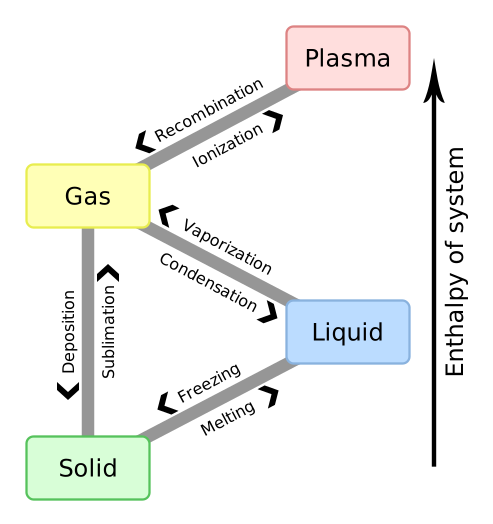
Phase changes occur when the kinetic energy of particles within a substance reaches a point where they can overcome or succumb to intermolecular forces. For instance, in melting, adding heat increases the vibrational energy of atoms or molecules in a solid until they break free from their fixed lattice positions, allowing them to move past each other as a liquid. At the boiling point, sufficient energy is supplied for particles to overcome attractive forces entirely, transitioning into a gas where they move independently and rapidly. Conversely, cooling a gas reduces particle kinetic energy, allowing intermolecular forces to pull them closer, leading to condensation into a liquid. The specific temperature and pressure at which these transitions happen are dictated by the substance's unique chemical structure and the strength of its interatomic or intermolecular bonds. For example, water's relatively high boiling point is due to strong hydrogen bonds between its molecules.
📊 Key Facts & Numbers
The melting point of water at standard atmospheric pressure is 0°C (32°F), while its boiling point is 100°C (212°F). Sublimation, the direct transition from solid to gas, occurs for dry ice (solid CO2) at -78.5°C (-109.3°F) and 1 atm. Supercritical fluids, existing above their critical temperature and pressure, exhibit properties of both liquids and gases; for CO2, this critical point is 31.1°C (88°F) and 72.8 atm. Organizations like the American Chemical Society and the American Physical Society host numerous conferences and publish journals dedicated to research on thermodynamics and material science, including phase changes. Major research institutions like MIT and Stanford University have departments actively engaged in exploring novel phase transitions and their applications.
👥 Key People & Organizations
Key figures in the study of phase transitions include J. Willard Gibbs, whose work laid the foundation for chemical thermodynamics and introduced the phase rule. Organizations like the American Chemical Society and the American Physical Society host numerous conferences and publish journals dedicated to research on thermodynamics and material science, including phase changes. Major research institutions like MIT and Stanford University have departments actively engaged in exploring novel phase transitions and their applications.
🌍 Cultural Impact & Influence
Phase changes are deeply embedded in human culture and daily life. The ability to freeze water for preservation or melt metals for crafting has been fundamental to technological development for millennia. The dramatic visual spectacle of a volcanic eruption, involving molten rock transitioning to solid basalt, has inspired awe and fear throughout history. In art and literature, the transformation of states—from a barren winter landscape to a vibrant spring—serves as a powerful metaphor for change, renewal, and emotional shifts. The concept of 'boiling point' itself has entered common parlance to describe a state of extreme tension or anger. Furthermore, the precise control of phase changes is critical in industries ranging from food processing (freezing, drying) to pharmaceuticals (crystallization) and materials engineering (heat treatment of metals).
⚡ Current State & Latest Developments
Current research is pushing the boundaries of understanding phase transitions into exotic states of matter and exploring their quantum mechanical underpinnings. Scientists are investigating phenomena like topological phase transitions, which involve changes in the fundamental mathematical properties of a material's electronic structure, leading to unique conductive properties. The study of superconductivity and superfluidity continues to reveal complex phase behaviors at extremely low temperatures, with potential applications in energy transmission and quantum computing. Researchers are also exploring phase transitions in biological systems, such as protein folding and the formation of cellular structures, and in complex fluids like liquid crystals used in displays. The development of advanced computational models, including density-functional theory, allows for more accurate predictions of phase diagrams and transition behaviors for novel materials.
🤔 Controversies & Debates
One persistent debate revolves around the classification of phase transitions. While Lev Landau's theory of second-order phase transitions, based on symmetry breaking, has been highly influential, it faces challenges in explaining certain complex phenomena. The role of fluctuations near critical points, particularly in lower dimensions, led to the development of renormalization group theory by Kenneth Wilson, which provided a more comprehensive understanding but also introduced significant mathematical complexity. Another area of contention is the precise mechanism of nucleation and growth during first-order transitions; while models exist, predicting these processes accurately for complex systems remains difficult. The potential for unexpected phase transitions in engineered materials also raises questions about material stability and reliability under extreme conditions.
🔮 Future Outlook & Predictions
The future of phase change research is poised to unlock materials with unprecedented properties. Scientists anticipate discovering new topological phases of matter that could revolutionize electronics and quantum computing, enabling faster and more energy-efficient devices. The quest for room-temperature superconductors, which would eliminate energy loss in electrical transmission, remains a major frontier, with ongoing research into novel material compositions and structures. Furthermore, understanding and controlling phase transitions in biological systems could lead to breakthroughs in medicine, such as designing targeted drug delivery mechanisms or understanding disease progression at a molecular level. The development of 'smart materials' that can reversibly change their properties (e.g., shape, color) in response to external stimuli, driven by controlled phase transitions, will likely see increased application in robotics, aerospace, and consumer products.
💡 Practical Applications
Phase changes are fundamental to countless industrial processes. In metallurgy, controlled heating and cooling cycles (heat treatment) induce phase changes in metals like steel to alter their hardness, strength, and ductility. The food industry relies heavily on phase changes for preservation (freezing, dehydration) and texture modification (cooking, emulsification). Refrigeration and air conditioning systems operate by exploiting the phase change of refrigerants, which absorb heat as they evaporate and release heat as they conden
Key Facts
- Category
- science
- Type
- topic