
Contents
Overview
The journey to redefine the SI base units began long before the 2019 implementation, rooted in the very inception of standardized measurement. The initial SI, established in 1960, still relied on physical prototypes for several units, most notably the kilogram, defined by the International Prototype of the Kilogram (IPK), a platinum-iridium cylinder housed at the International Bureau of Weights and Measures (BIPM) in Sèvres, France. Concerns about the IPK's stability, evidenced by slight mass variations over time, coupled with advancements in metrology, spurred a decades-long effort to anchor all units to fundamental physical constants. Precedents were set with the redefinition of the metre in 1983 based on the speed of light, and the second in 1967 based on atomic transitions in cesium-133. The 2019 redefinition culminated years of research and international consensus, with the General Conference on Weights and Measures formally approving the changes in November 2018, marking a profound philosophical and practical shift in metrology.
⚙️ How It Works
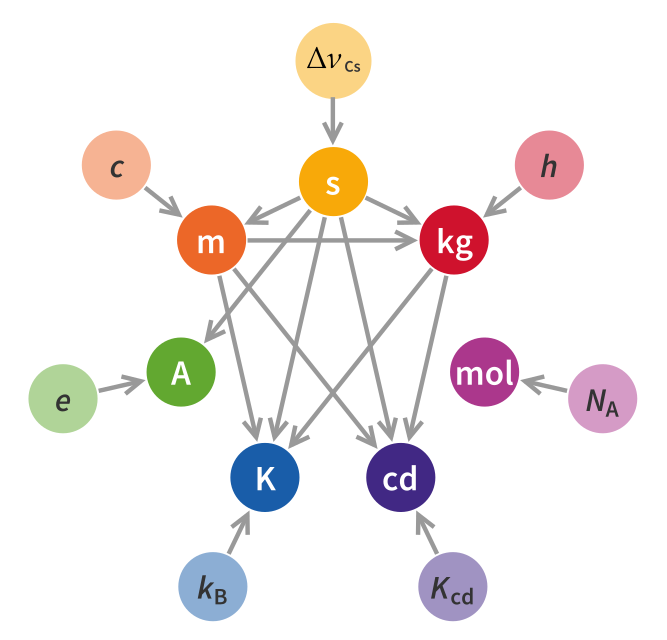
The core of the 2019 redefinition lies in assigning exact values to fundamental physical constants, thereby defining the base units. For instance, the kilogram is now defined by fixing the numerical value of the Planck constant (h) to exactly 6.62607015 × 10⁻³⁴ J⋅s (joule-seconds). This means that one kilogram is the mass that imparts this specific value to the Planck constant. Similarly, the ampere is defined by fixing the elementary electric charge (e) to 1.602176634 × 10⁻¹⁹ C (coulombs), meaning an ampere is the flow of this many elementary charges per second. The kelvin is defined by fixing the Boltzmann constant (kB) to 1.380649 × 10⁻²³ J/K (joules per kelvin), and the mole by fixing the Avogadro constant (NA) to 6.02214076 × 10²³ mol⁻¹ (reciprocal moles). This approach ensures that the units are no longer tied to potentially unstable physical objects but to universal, unchanging physical laws, allowing for greater precision and consistency across different laboratories and time.
📊 Key Facts & Numbers
The 2019 redefinition involved precise numerical values for four key constants. The Planck constant (h) was fixed at precisely 6.62607015 × 10⁻³⁴ J⋅s, directly defining the kilogram. The elementary electric charge (e) was set at exactly 1.602176634 × 10⁻¹⁹ C, defining the ampere. The Boltzmann constant (kB) received an exact value of 1.380649 × 10⁻²³ J/K, defining the kelvin. Finally, the Avogadro constant (NA) was fixed at 6.02214076 × 10²³ mol⁻¹, defining the mole. These exact values mean that the uncertainty in the definitions of these units is now zero. Prior to this, the kilogram's definition had an uncertainty of about 20 parts per billion, while the ampere and kelvin had uncertainties of around 10 parts per billion and 25 parts per billion, respectively. The redefinition ensures that the value of any unit remains unchanged, with the goal of improving the SI's metrological performance and universality.
👥 Key People & Organizations
The successful redefinition of the SI base units was a monumental achievement driven by a global network of scientists and metrologists. Key figures include Dr. Terrence Quinn, former Director of the BIPM, who played a crucial role in advocating for and guiding the redefinition process. The International Committee for Weights and Measures (CIPM) and its Consultative Committees, particularly the Consultative Committee for Units (CCU), were instrumental in developing the proposals. National Metrology Institutes (NMIs) worldwide, such as the National Institute of Standards and Technology (NIST) in the United States and the National Physical Laboratory (NPL) in the UK, conducted the extensive research and experiments necessary to determine the constants with sufficient accuracy. The General Conference on Weights and Measures served as the ultimate decision-making body, approving the changes based on the scientific consensus built by these organizations and individuals.
🌍 Cultural Impact & Influence
The 2019 redefinition of SI units has profound cultural and scientific implications, solidifying a universal language of measurement grounded in nature itself. It represents a triumph of scientific collaboration and a commitment to objective reality, moving away from human-made artifacts that are inherently subject to change and decay. This shift enhances the credibility and universality of scientific findings, ensuring that experiments conducted in different eras and locations can be directly compared. For the public, while the immediate impact might be subtle, it underpins the accuracy of technologies we rely on daily, from GPS systems to medical devices. The redefinition also serves as an educational moment, highlighting the fundamental constants that govern our universe and fostering a deeper appreciation for the precision of scientific measurement, influencing how we perceive and interact with the physical world.
⚡ Current State & Latest Developments
As of 2024, the redefinitions are fully integrated into scientific practice and industrial standards. National Metrology Institutes continue to refine their methods for realizing the defined units, focusing on achieving higher levels of accuracy in measurements of the fundamental constants. For example, ongoing research at various NMIs aims to improve the precision of watt balance experiments used to realize the kilogram, and experiments measuring the Josephson effect for voltage and the quantum Hall effect for resistance are continuously being optimized. The International Bureau of Weights and Measures (BIPM) plays a central role in coordinating these efforts through its key comparisons and calibration services. The focus now shifts towards leveraging the new definitions for more demanding applications, such as in quantum computing and advanced materials science, where extreme precision is paramount.
🤔 Controversies & Debates
While the 2019 redefinition was met with widespread scientific approval, some debates and challenges persist. One area of discussion revolves around the practical implementation and accessibility of the new definitions, particularly for smaller laboratories or industries that may not have the resources for highly sophisticated measurement equipment. The transition required significant investment in new apparatus and expertise. Furthermore, while the definitions are based on constants, the practical realization of these units still involves experimental measurements, which inherently carry uncertainties. The pursuit of ever-greater precision in these realizations, and the potential for discrepancies between different realization methods, remains an ongoing scientific endeavor. Some also question the complexity of the new definitions compared to the older, more tangible artifact-based standards, though the scientific community largely views this as a necessary evolution.
🔮 Future Outlook & Predictions
The future of the SI system, post-2019 redefinition, points towards an era of unprecedented measurement precision and universality. Scientists anticipate that the stable, constant-based definitions will enable breakthroughs in fields requiring ultra-precise measurements, such as quantum metrology, advanced semiconductor manufacturing, and fundamental physics research. The BIPM and NMIs will continue to refine the experimental techniques for realizing the base units, potentially leading to even more accurate measurements of the fundamental constants themselves. There's also speculation about future expansions or refinements of the SI, possibly incorporating new physical phenomena or constants as our understanding of physics deepens. The goal remains a metrological system that is not only stable and universal but also capable of meeting the ever-increasing demands of scientific discovery and technological innovation.
💡 Practical Applications
The practical applications of the redefined SI units are vast and touch nearly every aspect of modern life, even if indirectly. In manufacturing, the precise definition of the kilogram ensures consistency in the production of goods, from pharmaceuticals to microchips. The redefined ampere is critical for the electronics industry, underpinning the performance and reliability of electrical components and power systems. The kelvin's def
Key Facts
- Category
- science
- Type
- topic