
Contents
Overview
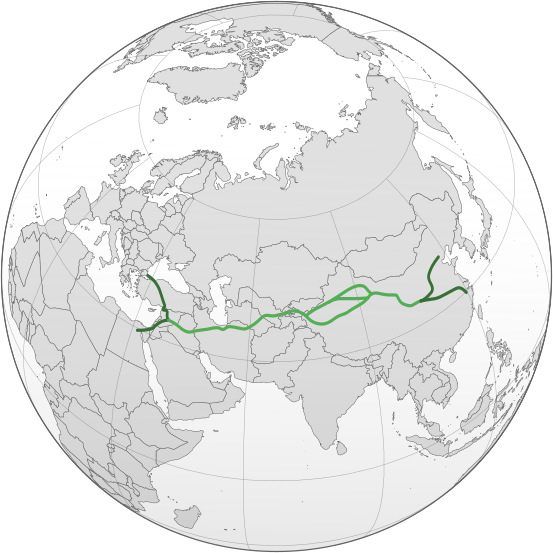
The genesis of the Silk Road can be traced to the Han Dynasty's expansion westward in the 2nd century BCE, particularly the missions of Zhang Qian around 138 BCE. His expeditions, initially aimed at forging alliances against the Xiongnu confederation, inadvertently opened up direct contact with Central Asian kingdoms like Bactria and Parthia, revealing lucrative trade possibilities. This period saw the initial flow of Chinese silk westward, a commodity that would become synonymous with the routes. Precursors to this network existed for millennia, with regional trade in jade, lapis lazuli, and horses, but Zhang Qian's journeys are widely credited with formalizing and expanding these connections into a transcontinental system. The routes evolved over centuries, influenced by the rise and fall of empires such as the Roman Empire, Sasanian Empire, Tang Dynasty, and the Mongol Empire, each leaving their mark on the flow of goods and ideas.
⚙️ How It Worked
The Silk Road operated as a relay system, with goods passing through numerous intermediaries across vast distances rather than being transported by a single merchant from end to end. Caravans, often composed of camels and horses, traversed treacherous terrains, including deserts like the Taklamakan and mountain ranges like the Pamir Mountains. Key oasis cities such as Samarkand, Bukhara, and Kashgar served as vital hubs for rest, resupply, and exchange. Maritime routes, equally crucial, connected ports in the Indian Ocean and the Persian Gulf to the Red Sea and the Mediterranean. The economic engine was driven by demand for high-value, low-volume goods, with silk being the most famous, but also including spices, precious stones, metals, glass, and paper. The logistical challenges were immense, requiring sophisticated networks of guides, translators, and local knowledge.
📊 Key Facts & Numbers
The Silk Road facilitated the movement of an estimated 10 million tons of goods annually at its peak, though precise figures are difficult to ascertain. Over its operational lifespan of roughly 1,700 years, the total volume of trade likely amounted to trillions of dollars in modern currency. The network spanned approximately 6,400 kilometers (4,000 miles) of land routes, connecting at least 40 modern-day countries. The Tang Dynasty (618-907 CE) is often considered a golden age, with trade volume increasing by an estimated 30% during this period. The Mongol Empire's unification of much of Eurasia in the 13th century further boosted trade, with estimates suggesting a 50% increase in the flow of goods and people across the continent. The decline of overland trade accelerated after the Ottoman Empire's conquest of Constantinople in 1453, which disrupted established routes and contributed to a 75% increase in maritime trade costs for European merchants.
👥 Key People & Organizations
While no single entity 'owned' the Silk Road, several empires and organizations played pivotal roles in its maintenance and expansion. The Han Dynasty (206 BCE – 220 CE) and the Tang Dynasty (618–907 CE) in China were instrumental in securing the eastern sections and fostering trade. The Roman Empire and its successor states, along with the Sasanian Empire (224–651 CE) in Persia, controlled the western termini. The Mongol Empire, under leaders like Genghis Khan and his successors, created an unprecedented period of stability and facilitated safe passage across vast swathes of Eurasia in the 13th and 14th centuries, with figures like Marco Polo famously traversing these routes. Later, the Ottoman Empire exerted significant control over key land routes, influencing their eventual decline.
🌍 Cultural Impact & Influence
The Silk Road's impact extends far beyond commerce, acting as a conduit for profound cultural and technological diffusion. Buddhism spread from India to Central Asia and East Asia, carried by monks and merchants along these routes, transforming societies in places like China and Japan. Technologies such as papermaking, gunpowder, and the compass, originating in China, made their way westward, revolutionizing European societies. Hellenistic art influenced Buddhist iconography in Afghanistan and beyond, and crops like grapes and alfalfa were introduced to China. The spread of Islam across Central Asia and into parts of China was also facilitated by these trade networks. Even diseases, most notably the Black Death in the 14th century, traveled along these routes, causing devastating pandemics across Eurasia.
⚡ Current State & Latest Developments
In the 21st century, the concept of the Silk Road has been revitalized, most notably through China's Belt and Road Initiative (BRI), launched in 2013. This ambitious global infrastructure development strategy aims to recreate and expand upon the ancient trade networks, focusing on modern transportation, energy, and digital infrastructure. The BRI involves investments in ports, railways, roads, and telecommunications across dozens of countries, aiming to boost trade and economic integration, particularly between Asia, Europe, and Africa. While proponents herald it as a new era of global connectivity, critics raise concerns about debt sustainability, environmental impact, and geopolitical influence, mirroring some of the historical tensions associated with large-scale trade networks. The initiative has already seen significant infrastructure projects completed, such as the China-Pakistan Economic Corridor.
🤔 Controversies & Debates
The very notion of a singular 'Silk Road' is a subject of considerable debate among historians. Some scholars, like Peter Frankopan, argue that the term overemphasizes silk and the East-West axis, neglecting the crucial role of Central Asian peoples and the North-South trade flows. Critics contend that the term, coined by Ferdinand von Richthofen in 1877, is a Eurocentric construct that privileges sedentary empires and overlooks the dynamic contributions of nomadic groups who were essential facilitators of trade. There's also debate about the extent to which these were 'roads' versus a fluid network of routes, and the relative importance of land versus sea passages. The impact of diseases, particularly the Black Death, is another area of ongoing research, with discussions focusing on the speed and mechanisms of its spread via these networks.
🔮 Future Outlook & Predictions
The future of Silk Road-inspired connectivity is largely tied to the success and geopolitical reception of China's Belt and Road Initiative. Projections suggest that if fully realized, the BRI could significantly alter global trade patterns, potentially rerouting a substantial portion of international commerce through Central Asia and China. Experts anticipate increased economic integration in Eurasia, but also potential for heightened geopolitical competition and regional instability. The development of new transportation corridors, including high-speed rail and modernized ports, could reduce transit times by up to 50% for certain routes. Furthermore, the expansion of digital infrastructure under the BRI, often termed the 'Digital Silk Road', points towards a future where data flows as significantly as physical goods, raising new questions about governance and access.
💡 Practical Applications
The historical Silk Road's legacy informs modern applications in logistics, international relations, and cultural exchange. The principles of intermediary trade and hub-and-spoke networks established along the ancient routes are foundational to contemporary global supply chains managed by companies like FedEx and UPS. The geopolitical strategies employed by empires to control and tax trade along the Silk Road offer parallels to modern discussions about infrastructure investment and economic influence, as seen with the Belt and Road Initiative. Furthermore, the historical cross-pollination of ideas and technologies serves as a model for contemporary efforts in international scientific collaboration and cultural
Key Facts
- Category
- history
- Type
- topic