
Contents
Overview
The concept of system design has evolved significantly alongside the development of computing. Early systems were often monolithic, with all components tightly integrated. As software complexity grew, so did the need for more structured approaches. The rise of distributed systems, microservices, and cloud computing in the late 20th and early 21st centuries further emphasized the importance of robust system design principles. Key figures like Edsger W. Dijkstra, with his work on structured programming, and later thought leaders in distributed systems, laid the groundwork for modern system design practices, influencing platforms like Google and Amazon.
⚙️ How It Works
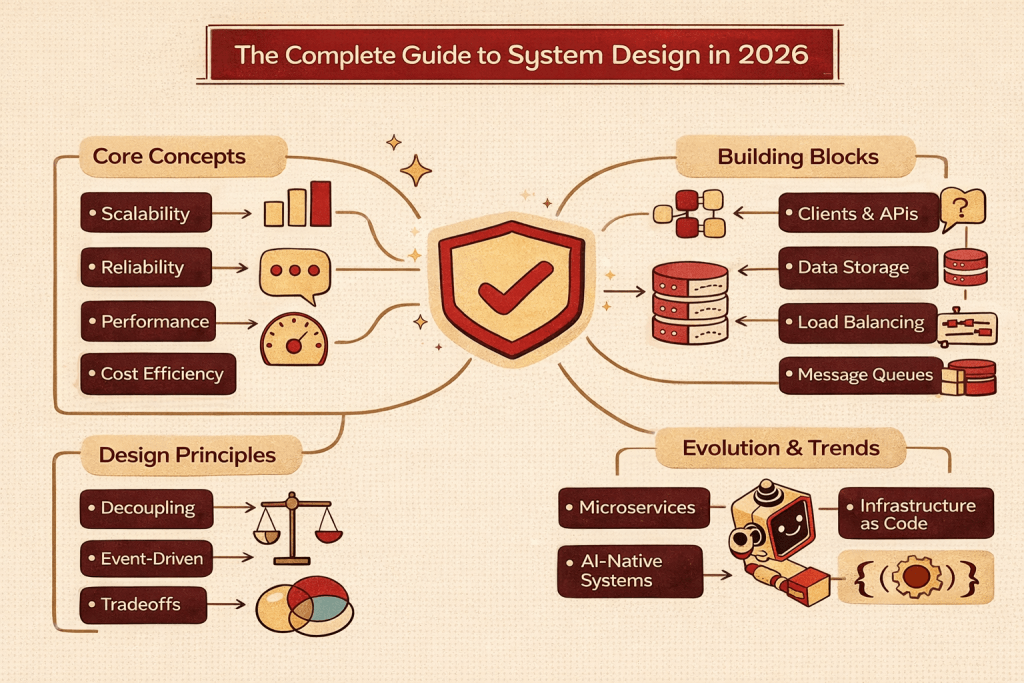
At its core, system design involves translating user requirements into a technical blueprint. This includes defining functional requirements (what the system does) and non-functional requirements (how it performs, e.g., scalability, reliability, security). High-Level Design (HLD) outlines the overall architecture, major components, and their interactions, often visualized with diagrams. Low-Level Design (LLD) then details the internal logic, classes, and data structures for each component. Essential considerations include scalability (horizontal vs. vertical), databases (SQL vs. NoSQL), caching strategies, load balancing, and API design, as explored in resources like GeeksforGeeks and roadmap.sh.
🌍 Cultural Impact
System design is fundamental to the success of countless digital products and services that shape our daily lives. From the seamless streaming experience on Netflix and the real-time ride-hailing of Uber to the vast social networks of Facebook and the instant communication on WhatsApp, effective system design underpins their functionality and scalability. The principles of system design are also crucial for interview preparation at major tech companies like Google and Microsoft, where candidates are expected to demonstrate an understanding of how to build robust, large-scale systems, as highlighted by resources like Exponent and Medium articles.
🔮 Legacy & Future
The future of system design is deeply intertwined with advancements in AI, machine learning, and edge computing. Designing systems that can effectively leverage AI models, manage massive datasets for ML training, and operate efficiently at the edge presents new challenges and opportunities. Concepts like event-driven architectures, serverless computing, and robust observability will continue to be paramount. As systems become more complex and interconnected, the ability to design for resilience, security, and maintainability, as emphasized by the U.S. Web Design System, will remain a cornerstone of technological innovation.
Key Facts
- Year
- Evolved over decades, with significant acceleration in the 21st century
- Origin
- Computer science and software engineering
- Category
- technology
- Type
- concept
Frequently Asked Questions
What is the difference between High-Level Design (HLD) and Low-Level Design (LLD)?
High-Level Design (HLD) focuses on the overall architecture, major components, and their interactions, providing a broad overview of the system. Low-Level Design (LLD), on the other hand, delves into the detailed implementation of each component, including classes, methods, and data structures. HLD is like the blueprint of a building, while LLD is like the detailed architectural drawings for each room and its fixtures.
Why is scalability important in system design?
Scalability is crucial because it allows a system to handle increasing amounts of work or users without degrading performance. This can be achieved through horizontal scaling (adding more machines) or vertical scaling (increasing the capacity of existing machines). Without proper scalability, a system can become slow or unavailable as its user base or data volume grows, impacting user experience and business operations, as seen with platforms like Netflix and Twitter.
What are some common system design interview resources?
Popular resources for learning system design include online platforms like roadmap.sh, GeeksforGeeks, Exponent, and Medium articles. Books such as 'Designing Data-Intensive Applications' by Martin Kleppmann and 'System Design Interview' by Alex Xu are also highly recommended. YouTube channels and courses from providers like freeCodeCamp.org and Coursera offer structured learning paths.
What is the CAP theorem and why is it relevant to system design?
The CAP theorem states that a distributed data store can only provide two out of three guarantees: Consistency, Availability, and Partition Tolerance. In system design, understanding this theorem is vital for making informed trade-offs when designing distributed systems, as it dictates how data will be handled in the event of network failures, influencing choices made for platforms like Google's Spanner or Amazon's DynamoDB.
How do design principles like Separation of Concerns and Loose Coupling apply to system design?
Separation of Concerns involves breaking down a system into distinct modules, each handling a specific function, making the system easier to manage and test. Loose Coupling aims to reduce the interdependencies between these modules, so changes in one part have minimal impact on others. These principles, discussed in resources like GeeksforGeeks, are fundamental to building maintainable, scalable, and resilient systems, contrasting with tightly coupled monolithic architectures.
References
- roadmap.sh — /system-design
- geeksforgeeks.org — /system-design/system-design-tutorial/
- reddit.com — /r/softwarearchitecture/comments/1owsg6p/how_do_i_properly_learn_system_design_n
- youtube.com — /watch
- hellointerview.com — /learn/system-design/in-a-hurry/introduction
- youtube.com — /watch
- medium.com — /@sentalkssane/a-beginners-guide-to-system-design-76d64689788b
- en.wikipedia.org — /wiki/Systems_design