
Contents
Overview
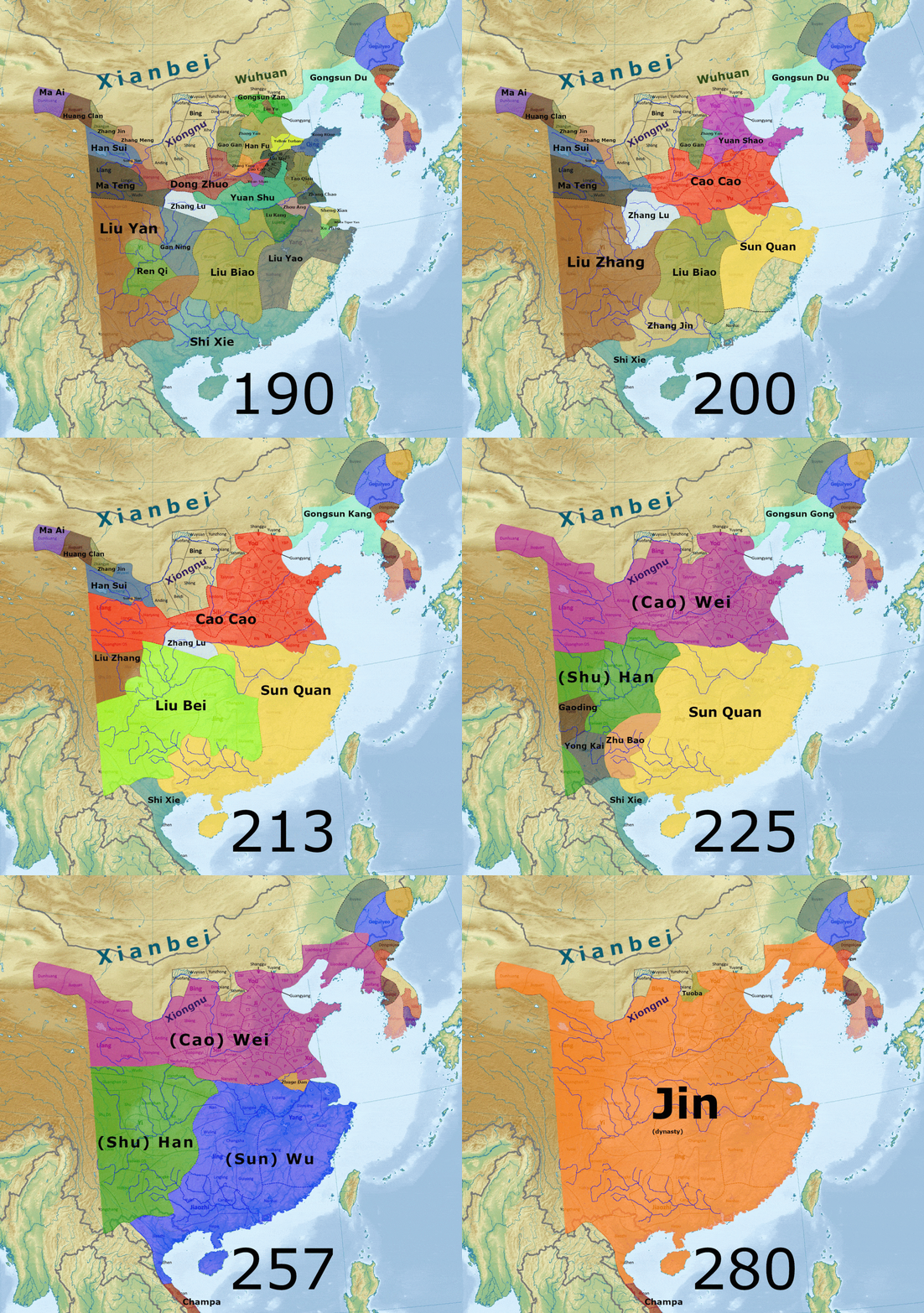
The Three Kingdoms period emerged from the decline of the Han Dynasty. Figures like Dong Zhuo and Yuan Shao carved out territories, but it was Cao Cao who consolidated power in the north, laying the foundation for the state of Cao Wei. His son, Cao Pi, formally ended the Han Dynasty, establishing Wei. Meanwhile, Liu Bei, claiming legitimacy through his Han ancestry, established Shu Han in the southwest with the aid of legendary strategists like Zhuge Liang. The third pillar, Eastern Wu, emerged under the Sun family in the southeast, notably through the leadership of Sun Quan. This tripartite division, solidified by the Battle of Red Cliffs, defined the era until the Jin Dynasty's eventual conquest.
⚙️ How It Works
The 'working' of the Three Kingdoms was a brutal ballet of military might and diplomatic chess. Each state operated under distinct philosophies and strategic imperatives. Cao Wei, possessing the most populous and economically developed northern heartland, relied on its superior manpower and established bureaucracy, often employing direct military offensives. Shu Han, though smaller, championed Confucian ideals of benevolent rule and sought to legitimize its claim through its supposed Han lineage, often employing guerrilla tactics and strategic alliances, most famously with Eastern Wu. Eastern Wu leveraged its naval superiority and control of vital trade routes along the Yangtze River, employing a defensive strategy that proved remarkably resilient. The constant threat of invasion and the need for resources fueled innovation in siege warfare, logistics, and espionage, making the period a crucible for military strategy that would influence warfare for centuries.
📊 Key Facts & Numbers
The Three Kingdoms era was a period of immense demographic upheaval and significant military scale. The population of China, estimated at around 50-60 million during the late Han Dynasty, may have plummeted to as low as 20 million by the end of the period, a stark indicator of the widespread famine, plague, and warfare. Over 100 major battles are recorded, involving hundreds of thousands of soldiers, with the Battle of Red Cliffs alone reportedly seeing over 200,000 combatants on one side. Cao Wei commanded the largest armies, often exceeding 200,000 active troops, while Shu Han and Eastern Wu fielded forces typically ranging from 50,000 to 100,000. The economic output of the northern plains under Wei was estimated to be nearly double that of Shu and Wu combined. The period lasted approximately 60 years, from the formal establishment of Wei in 220 AD to the fall of Wu in 280 AD.
👥 Key People & Organizations
The stage of the Three Kingdoms was dominated by larger-than-life figures whose names still resonate. Cao Cao (155-220 AD), the de facto founder of Cao Wei, was a brilliant but ruthless strategist and poet. His son, Cao Pi (187-226 AD), officially ended the Han Dynasty. Liu Bei (161-223 AD), a charismatic leader who claimed Han imperial lineage, founded Shu Han, often portrayed as the righteous claimant. His sworn brothers, the fearsome warrior Guan Yu and the loyal general Zhang Fei, are legendary figures. Zhuge Liang (181-234 AD), Liu Bei's brilliant chancellor, became the archetypal wise strategist. In the south, Sun Quan (182-252 AD) ruled Eastern Wu for over 50 years, a testament to his political longevity. The Luo Guanzhong novel, Romance of the Three Kingdoms, immortalized these figures, though often with dramatic embellishments, shaping their historical perception for millennia.
🌍 Cultural Impact & Influence
The cultural footprint of the Three Kingdoms is immense, extending far beyond China's borders. The novel Romance of the Three Kingdoms is one of the Four Great Classical Novels of Chinese literature, influencing countless subsequent works of art, opera, and storytelling across East Asia, including Korea, Japan, and Vietnam. The characters and their exploits have become deeply ingrained in popular culture, serving as archetypes for loyalty (Guan Yu), wisdom (Zhuge Liang), ambition (Cao Cao), and righteousness (Liu Bei). Strategic principles derived from this era, such as the 'Thirty-Six Stratagems', are still studied in military academies and business schools worldwide. The period's narratives have inspired numerous video games, films, and television series, demonstrating its enduring appeal as a source of dramatic conflict and heroic sagas.
⚡ Current State & Latest Developments
While the historical period concluded in 280 AD, the narrative of the Three Kingdoms remains vibrantly alive in the 21st century. The enduring popularity of the Romance of the Three Kingdoms novel continues to fuel new adaptations. The historical drama series 'Three-Body Problem' on Netflix drew parallels between ancient Chinese strategy and modern geopolitical tensions, indirectly referencing the era's strategic depth. Video games like Dynasty Warriors and Total War: Three Kingdoms continue to attract millions of players, offering interactive experiences of the period's battles and political intrigue. Academic interest also persists, with ongoing archaeological discoveries and reinterpretations of historical texts, such as the Records of the Three Kingdoms by Chen Shou, providing fresh perspectives on the era's complexities.
🤔 Controversies & Debates
The primary controversy surrounding the Three Kingdoms centers on the historical accuracy versus the fictionalized portrayal in Romance of the Three Kingdoms. While Luo Guanzhong's novel is a literary masterpiece, it significantly dramatized events and characters, often favoring Liu Bei and Shu Han while demonizing Cao Cao. Historians debate the extent to which the novel's narrative has overshadowed factual accounts, leading to popular misconceptions about the period's key figures and their motivations. Another debate concerns the true demographic impact of the era; while population figures suggest a catastrophic decline, some scholars argue that the data might be incomplete or exaggerated, and that regional recovery was more rapid than commonly believed. The moral interpretations of figures like Cao Cao, often depicted as a villain, are also contested, with many historians arguing for a more nuanced understanding of his complex legacy.
🔮 Future Outlook & Predictions
The future of the Three Kingdoms narrative lies in further blending historical rigor with engaging digital experiences. Expect more sophisticated historical simulations and augmented reality applications that allow users to explore battlefields and cities of the era. Academic research will likely focus on interdisciplinary approaches, combining textual analysis with archaeological findings to reconstruct the period's social, economic, and environmental conditions with greater precision. Furthermore, as global interest in Chinese history and culture grows, we may see more international co-productions of films and series that explore the era's universal themes of loyalty, ambition, and the struggle for power, potentially reaching new audiences through platforms like Disney+ or Amazon Prime Video. The enduring archetypes of its heroes and villains will undoubtedly continue to be reinterpreted for contemporary relevance.
💡 Practical Applications
The strategic and ethical lessons from the Three Kingdoms period remain remarkably practical. Military strategists still study the campaigns of figures like Zhuge Liang and Sima Yi for insights into logistics, deception, and long-term planning. Business leader
Key Facts
- Category
- history
- Type
- topic