
Contents
Overview
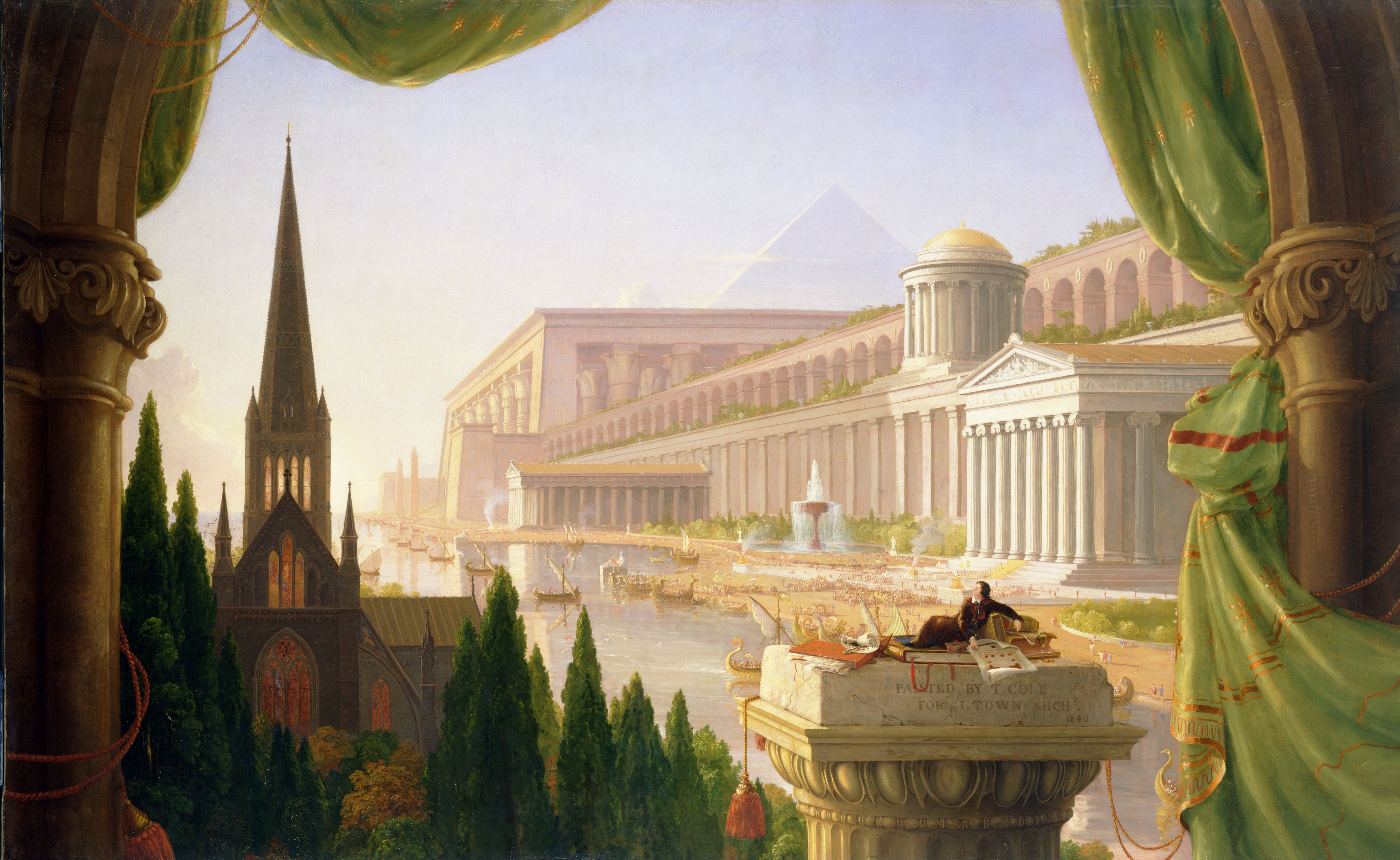
The story of Western architecture begins not with a single moment, but a gradual accumulation of ideas and techniques that coalesced in the Mediterranean basin. Early settlements, driven by the fundamental human need for shelter, evolved into more complex structures. The Minoan and Mycenaean civilizations laid groundwork with their monumental palaces and fortifications, hinting at sophisticated construction methods. However, it was in ancient Greece, particularly from the 6th century BCE onwards, that a distinct Western architectural language began to form. The development of the Doric, Ionic, and Corinthian orders provided a systematic vocabulary for temples and public buildings, emphasizing proportion, symmetry, and harmony, exemplified by the Parthenon on the Acropolis. The Romans, absorbing and adapting Greek principles, introduced revolutionary engineering feats like the arch, vault, and dome, enabling the construction of vast aqueducts, amphitheaters (such as the Colosseum), and basilicas, spreading this architectural DNA across their empire through structures like the Pantheon.
⚙️ How It Works
At its core, Western architecture operates through a systematic application of structural principles and aesthetic conventions that have evolved over centuries. The foundational elements often involve load-bearing walls, post-and-lintel systems, and later, the sophisticated use of arches, vaults, and domes to span larger spaces. The development of architectural orders in Classical antiquity provided a standardized system of proportions and ornamentation. The Gothic period introduced the pointed arch, ribbed vault, and flying buttress, allowing for unprecedented height and light in cathedrals like Notre-Dame. The Renaissance saw a revival of Classical forms, emphasizing symmetry and human scale, while the Baroque period embraced drama, grandeur, and elaborate ornamentation. Modernism, emerging in the late 19th and early 20th centuries, radically departed from historical styles, prioritizing function, new materials like steel and reinforced concrete, and abstract forms, as seen in the works of Le Corbusier and Walter Gropius at the Bauhaus.
📊 Key Facts & Numbers
The sheer scale of Western architecture is staggering: over 2,000 years of continuous development have produced millions of structures. The Classical period alone saw the construction of an estimated 10,000 Greek temples and 50,000 Roman temples across their empires. By the High Middle Ages, Europe boasted over 500 major Gothic cathedrals, with some, like Cologne Cathedral, taking over 600 years to complete. The skyscraper boom in the late 19th and early 20th centuries, beginning with the Home Insurance Building in Chicago (1885) at 10 stories, has since pushed heights to over 800 meters, with the Burj Khalifa standing at 828 meters. Globally, the construction industry, heavily influenced by Western methodologies, accounts for approximately 13% of global GDP, a figure exceeding $10 trillion annually.
👥 Key People & Organizations
Key figures have shaped the trajectory of Western architecture. Vitruvius, a Roman architect and engineer, authored De Architectura around 25 BCE, codifying Classical principles that influenced builders for over a millennium. During the Renaissance, Leon Battista Alberti and Filippo Brunelleschi revived Classical ideals and engineering prowess, with Brunelleschi famously engineering the dome of Florence Cathedral. Andrea Palladio's villas and treatise The Four Books of Architecture established a style that would echo through centuries, particularly in Palladianism. The Enlightenment saw architects like Robert Adam popularize Neoclassicism. The 19th century brought figures like Charles Garnier, architect of the Palais Garnier. The 20th century was dominated by Modernist pioneers such as Frank Lloyd Wright, Le Corbusier, Mies van der Rohe, and Walter Gropius, founders of the Bauhaus school, who fundamentally redefined architectural practice. Contemporary leaders include Zaha Hadid, Rem Koolhaas, and Norman Foster.
🌍 Cultural Impact & Influence
Western architecture's influence extends far beyond its geographical origins, permeating global building practices and urban development. The Classical orders, revived during the Renaissance and Neoclassical periods, became a universal language for civic buildings, banks, and government structures worldwide, symbolizing order, democracy, and power. Gothic Revival architecture, popular in the 19th century, left its mark on university campuses and religious buildings across continents. Modernist principles of functionalism, clean lines, and the use of new materials like steel and glass became the default for corporate headquarters and urban housing projects globally from the mid-20th century onwards. The very concept of the skyscraper, a distinctly Western innovation, has become a ubiquitous symbol of economic progress in major cities from Shanghai to Dubai. Even the planning of cities, from Haussmann's boulevards to the grid plans of American cities, reflects Western urban design philosophies.
⚡ Current State & Latest Developments
The current state of Western architecture is characterized by a complex interplay of historical reverence and forward-looking innovation. While postmodernism and deconstructivism offered critiques and stylistic departures in the late 20th century, there's a resurgence of interest in historical styles, often reinterpreted through contemporary technology. The dominant discourse now heavily emphasizes sustainability and green architecture, with architects like Bjarke Ingels integrating ecological concerns into high-profile projects. Digital design tools, including BIM and parametric modeling, are standard, enabling intricate geometries and optimized performance. The global spread of Western architectural firms means that styles and methodologies are constantly being adapted and hybridized in diverse cultural contexts, leading to a rich, albeit sometimes contested, global architectural dialogue.
🤔 Controversies & Debates
Western architecture is not without its controversies. The imposition of Western architectural styles during colonial periods often led to the erasure or marginalization of indigenous building traditions, a legacy still debated today. Modernism's utopian ideals, particularly its focus on large-scale social housing projects, often resulted in sterile, alienating environments, a critique famously articulated by Jane Jacobs in The Death and Life of Great American Cities. The pursuit of iconic, starchitect-designed buildings, while visually striking, is frequently criticized for exorbitant costs, environmental impact, and a disconnect from the needs of local communities. Furthermore, the historical exclusion of women and minority groups from formal architectural education and practice, a reality until well into the 20th century, continues to be a subject of critical re-examination and efforts towards greater inclusivity, championed by organizations like Architects/Designers/Planners for Social Responsibility (ADPSR).
🔮 Future Outlook & Predictions
The future of Western architecture appears poised for significant transformation, driven by pressing global challenges and emerging technologies. The imperative for climate change mitigation will undoubtedly push sustainable design to the forefront, with innovations in materials science (e.g., mass timber, bio-based composites) and energy-efficient systems becoming paramount. AI is expected to play an increasingly crucial role in design processes, from generative design to optimizing building performance and construction logistics. The concept of the smart city and the integration of buildings with digital infrastructure will continue to evolve. There's also a growing interest in adaptive reuse and the deconstruction and recycli
Key Facts
- Category
- aesthetics
- Type
- topic